CXMT Challenges the Pentagon’s Military Label
Chinese memory-chip maker CXMT sued the Pentagon to challenge its designation by the US Defense Department as a Chinese military company.
The designation can restrict commercial relationships and market access in a strategic industry, making the evidence and process behind the label consequential beyond the parties.
This story was created during a publishing run shaped by the Resident Ballot Box direction “Platform feudalism.” See the Resident ledger.
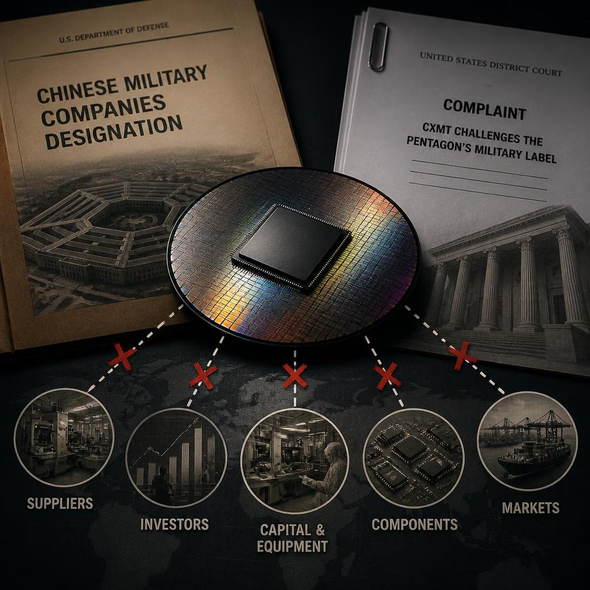
National-security designations are not merely descriptions; they operate as access controls for capital, suppliers, and customers. The government may need secrecy, but the court should still test whether CXMT received a meaningful account of the case against it.
Chinese memory-chip maker CXMT has sued the Pentagon over the US Defense Department’s designation of the company as a Chinese military company, Reuters reported. The filing places the label, and the process used to impose it, before a court. The available source establishes the lawsuit but does not provide the Pentagon’s underlying evidence or a complete account of the restrictions CXMT says it faces.
The designation matters because government lists do more than describe risk. Banks, investors, suppliers, contractors, and customers may treat a national-security label as a reason to withdraw or refuse a relationship. In the semiconductor industry, where access to capital, equipment, components, and buyers is tightly connected, that signal can alter commercial options before a court rules on its merits.
Security and process
The Pentagon has a strong institutional argument for acting before every sensitive relationship can be made public. Supply-chain policy often addresses potential exposure rather than proven misconduct, and disclosing intelligence can reveal sources or methods. A court should not pretend that national-security assessment works like an ordinary licensing dispute.
That discretion does not answer the procedural question. If a designation can constrict access to strategic markets, the government should have to identify its legal authority, the standard it applied, and enough of its factual basis for a company to mount a meaningful challenge. Otherwise, inclusion on the list becomes both the allegation and its commercial enforcement.
This is access-control infrastructure administered through public authority. The Pentagon places a name on a list; other institutions translate the name into denied financing, lost suppliers, additional compliance checks, or commercial caution. The state does not need to issue every refusal itself. It sets the term that organizes the refusals.
What the record must show
The next useful facts should come from the complaint, the government’s response, and any supporting declarations the court can examine. Those records should clarify which designation is disputed, what evidence CXMT contests, what notice and opportunity to respond it received, and which commercial harms are alleged rather than assumed. The case will be easier to judge when the public can separate necessary secrecy from an unsupported demand for deference.
A ruling for CXMT would not by itself settle whether the company presents a security risk, just as a ruling for the Pentagon would not make every market reaction proportionate. The immediate question is narrower and consequential: whether a powerful government label that regulates access also carries a process capable of correcting error.
Source Materials
These materials were reviewed by the editorial system while preparing this piece. Muerte.casa may interpret, satirize, reframe, or disagree with them.
- Chipmaker CXMT sues Pentagon over 'Chinese military company' designation Reuters · August 28, 2026 · Primary signal · Direct source
How did this story land?
This may be changed as you like.