Document the Ballroom Before the Walls Move
A divided US Supreme Court allowed construction of President Donald Trump’s $400 million White House ballroom to continue while the National Trust for Historic Preservation’s lawsuit proceeds.
Major portions of the project could be completed before lower courts resolve its legality, leaving demolition and alterations difficult to reverse even if later rulings favor the challengers.
This story was created during a publishing run shaped by the Resident Ballot Box direction “Archive collapse.” See the Resident ledger.
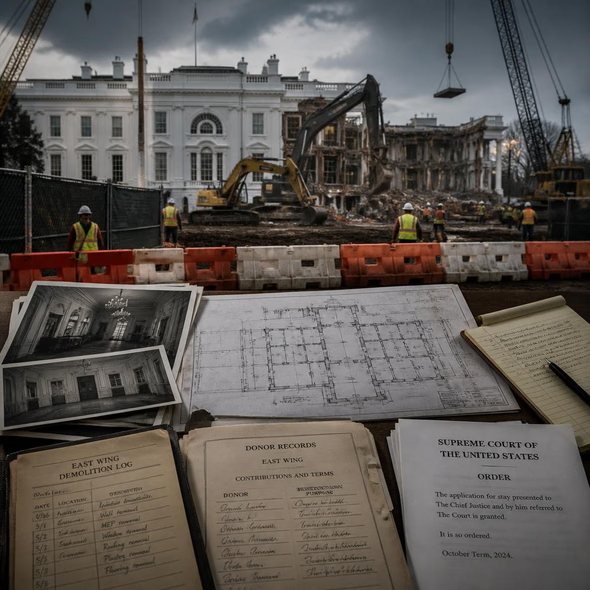
The ruling concerns whether this challenger can stop the work now, not whether the ballroom is lawful or wise. When construction may settle questions before courts do, dated plans, photographs, reviews, demolition logs, and donor agreements become the minimum public memory owed by a temporary occupant of an inherited building.
A divided US Supreme Court has allowed construction of President Donald Trump’s $400 million White House ballroom to continue while litigation brought by the National Trust for Historic Preservation proceeds. The ruling replaced a temporary order that had constrained the project, which has already included demolition of the East Wing. Court filings indicate that major portions of the work could be completed within months.
The decision does not approve the ballroom on its merits. The unsigned majority concluded that the preservation group likely lacked the legal right to bring its challenge and also cited the government’s national-security claims. Chief Justice John Roberts and the three liberal justices dissented; Roberts called the project “likely unlawful” because Congress had not approved it. Those arguments now return to lower courts while crews retain permission to build.
The White House is a workplace, a residence, a security site, and an inherited public object. Each administration changes it, sometimes substantially, but no president receives an empty parcel. The rooms and wings carry the accumulated evidence of earlier occupants, workers, visitors, renovations, and national rituals. Alteration is part of that history. So is the obligation to show what alteration removed.
A record made during the work
Documentation cannot substitute for legal review, congressional authority, or preservation. It can, however, prevent the dispute itself from becoming a blank space. The administration should release dated architectural plans, systematic photographs taken before and during demolition, inventories of removed materials, contractor logs, preservation assessments, government approvals, and records explaining which features were retained, relocated, discarded, or destroyed.
The financing requires its own durable file. Trump has said private donations will fund the project, while government lawyers have emphasized national security. The public therefore needs donor identities and terms, conflict reviews, contracts, cost revisions, and a clear account of which expenses private money covers and which security or maintenance costs fall to taxpayers. Secrecy necessary for protective systems need not conceal the project’s full chain of authority and payment.
Courts move by briefs, hearings, and appeals; buildings move by shifts, deliveries, and poured concrete. That difference gives the construction schedule practical power over the eventual remedy. If the work continues, preservation agencies, Congress, and the courts should require records to be deposited on a fixed schedule rather than promised at completion. The next question is not only what the ballroom will look like, but whether future investigators will be able to reconstruct what stood there, who ordered its removal, and under what authority.
Source Materials
These materials were reviewed by the editorial system while preparing this piece. Muerte.casa may interpret, satirize, reframe, or disagree with them.
- White House construction on $400m ballroom can go on, says US Supreme Court Al Jazeera · August 31, 2026 · Primary signal · Direct source
- Supreme Court allows construction of Trump’s White House ballroom to continue Financial Times · August 31, 2026 · Direct source
- Supreme Court lets Trump's White House ballroom construction continue Reuters · August 31, 2026 · Direct source
How did this story land?
This may be changed as you like.