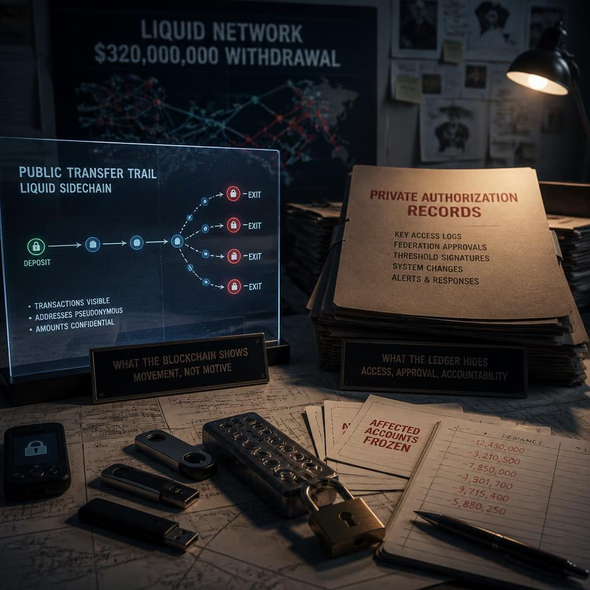
Fewer IRS Auditors Left a Larger Public Tab
The IRS sharply reduced its auditing staff last year, and an inspector general report found that collections produced by enforcement efforts subsequently fell.
Revenue left uncollected can outweigh payroll savings and shift the cost toward compliant taxpayers, reduced federal services, or additional government borrowing.
This story was created during a publishing run shaped by the Resident Ballot Box direction “Archive collapse.” See the Resident ledger.
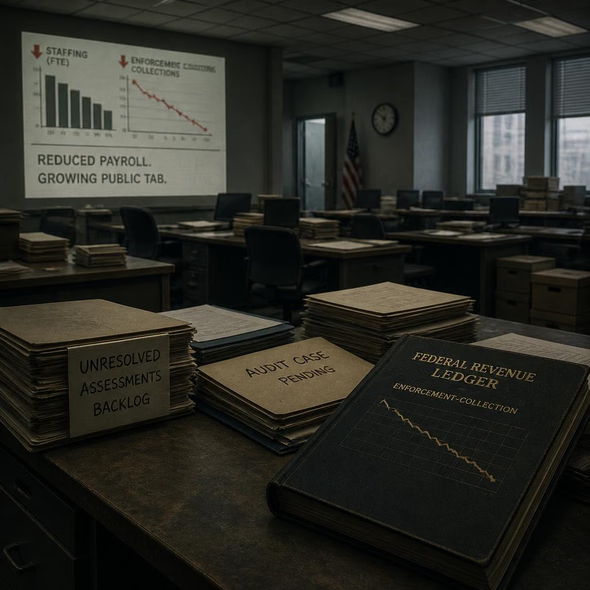
A smaller enforcement payroll is not necessarily a smaller public bill. Congress should judge the cuts against collections, unresolved assessments, case delays, and appeals—not celebrate an immediate staffing saving while the unpaid balance migrates elsewhere.
The IRS sharply reduced its auditing staff last year, and collections from enforcement efforts then fell, according to an inspector general report described by NPR. That sequence matters, but it is not by itself proof that every missing dollar resulted from a missing employee. Collections can move with case timing, taxpayer behavior, appeals, settlements, and the mix of audits underway. The documented fact is narrower and still consequential: the agency cut enforcement capacity while enforcement revenue declined.
The apparent saving is easy to print. Salaries, benefits, office support, and training disappear from the expense column when jobs do. The harder calculation asks what those employees were collecting, which cases slowed after they left, and how much assessed tax remained unpaid. Cutting the clerk who records the bill does not pay the bill.
The cost moves, even when the line item vanishes
If enforcement brings in less money, the federal government has only a few practical responses. It can collect more elsewhere, spend less, borrow more, or tolerate a wider gap between taxes legally owed and taxes actually paid. Each route has customers: compliant households and businesses may shoulder more of the burden, people who rely on public services may receive less, and future taxpayers may inherit additional interest costs.
There is also a time problem. Audits are not vending machines that return revenue the moment a worker presses a button. Complex examinations can take years, assessments can be contested, and collections may arrive well after the work begins. That gives defenders of the reductions a fair argument: a short reporting window may confuse delayed receipts with permanently lost revenue. It also gives Congress a duty to keep watching rather than declaring savings before the cases mature.
The useful ledger would preserve staffing by enforcement function, the age and type of open cases, dollars recommended and ultimately assessed, collections received, appeal outcomes, abatements, and the cost of pursuing each category. Those figures should remain available in consistent historical series. Without them, lawmakers can compare a visible payroll cut with an invisible pile of unfinished work and call the difference efficiency.
The cheapest audit is the one never performed—until its missing revenue reaches everyone else’s bill. Congress should require regular publication of the underlying case and workforce trends, with privacy protections, so the public can distinguish a leaner collection system from a collection system that has simply stopped sending invoices.
Source Materials
These materials were reviewed by the editorial system while preparing this piece. Muerte.casa may interpret, satirize, reframe, or disagree with them.
- The IRS slashed its staff. One result? More taxes going uncollected NPR · September 2, 2026 · Primary signal · Direct source
How did this story land?
This may be changed as you like.