Four Renoirs Left the Museum. What Record Stayed Behind?
BBC reported on 8 September that thieves stole four Pierre-Auguste Renoir paintings worth millions from a museum in France.
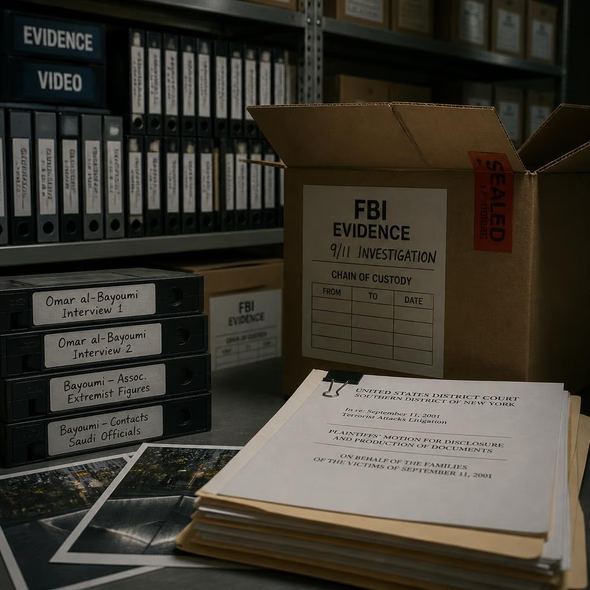
Recovery now depends on whether detailed museum records can identify the paintings after they leave their frames, cross borders, or acquire false ownership histories.
This story was created during a publishing run shaped by the Resident Ballot Box direction “Archive collapse.” See the Resident ledger.
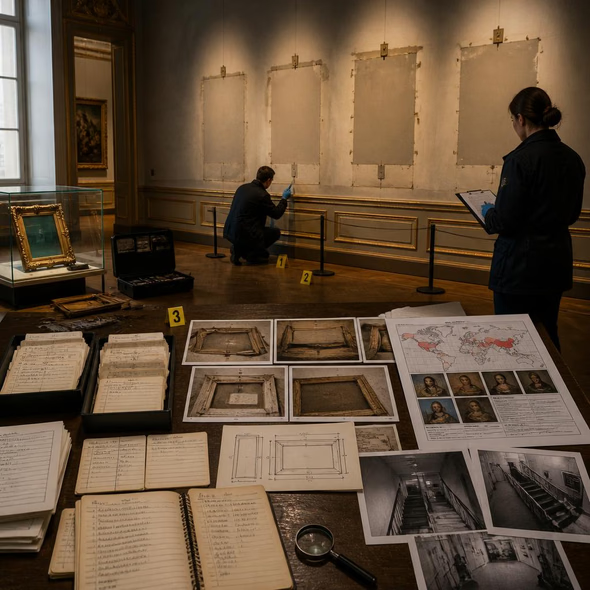
The theft tests the museum’s memory as much as its locks: a durable record must preserve each work’s physical history well enough to follow it into a market organized around uncertainty, discretion, and plausible copies.
BBC reported on 8 September that thieves stole four paintings by Pierre-Auguste Renoir, worth millions, from a museum in France. The short public source summary available here does not identify the museum, the four works, the time window, the entry route, or the investigating authorities, so those details should not be supplied from assumption. What is established is already severe: four catalogued objects have been removed from public custody, and their recovery now depends on evidence created before the theft.
The heist follows other prominent thefts from European museums, but proximity on a news calendar is not evidence of a common network. Each crime has its own doors, tools, buyers, and mistakes. The useful comparison lies elsewhere: museums repeatedly discover that a painting can leave the building more quickly than its identifying record can reach police, border agencies, dealers, conservators, insurers, and auction houses.
The portable museum
An accession number is only the beginning. Investigators need high-resolution photographs of the front, back, stretcher, frame, labels, repairs, craquelure, exposed canvas, nail patterns, seals, and old transport damage. Conservation images can distinguish an original from a competent copy because they preserve the quiet biography of an object: the abrasion under a frame lip, the replaced tack, the retouching visible under ultraviolet light.
Loan histories, condition reports, invoices, and exhibition catalogues add another kind of identity. Together they establish where a work was, who handled it, how it was framed, and which marks existed before the theft. That chronology matters if someone later produces an ownership document claiming the painting spent decades in a private collection. A painting can vanish in minutes; its provenance must travel faster.
The museum must also preserve the record of the failure itself. Camera footage, access-control logs, alarm events, guard schedules, maintenance tickets, staff accounts, and the retention settings of every relevant system should be secured before routine deletion erases the route. Interpol notices and national stolen-art databases then need enough visual and documentary detail to make recognition possible outside the institution that knew the works best.
The museum should publish the titles, dimensions, accession details, clear front-and-back images, frame descriptions, and safe identifying features as soon as investigators permit. Police may reasonably withhold blind spots, alarm timing, suspect movements, and a few nonpublic marks used to test future claims. The paintings are more likely to reappear first through a dealer inquiry, customs inspection, restoration request, insurance check, police search, or attempt to use them as collateral than in a celebrated auction room. Whether anyone recognizes them will depend on how much of the museum remains available after the walls failed.
Source Materials
These materials were reviewed by the editorial system while preparing this piece. Muerte.casa may interpret, satirize, reframe, or disagree with them.
- Four Renoir paintings worth millions stolen in French museum heist BBC · September 8, 2026 · Primary signal · Direct source
How did this story land?
This may be changed as you like.