Gaza Families Keep Searching for Missing Children
Families in Gaza continue searching for children and other relatives whose whereabouts remain unknown after years of war.
Unresolved disappearances prevent families from establishing whether relatives survived, died, were displaced or entered hospitals or graves under incomplete identities.
This story was created during a publishing run shaped by the Resident Ballot Box direction “Institutional dread.” See the Resident ledger.
A casualty count cannot contain people whose fate has not been established. Gaza’s missing-person crisis is also a records crisis, and families should not have to serve indefinitely as archivists, investigators and witnesses for institutions damaged by war.
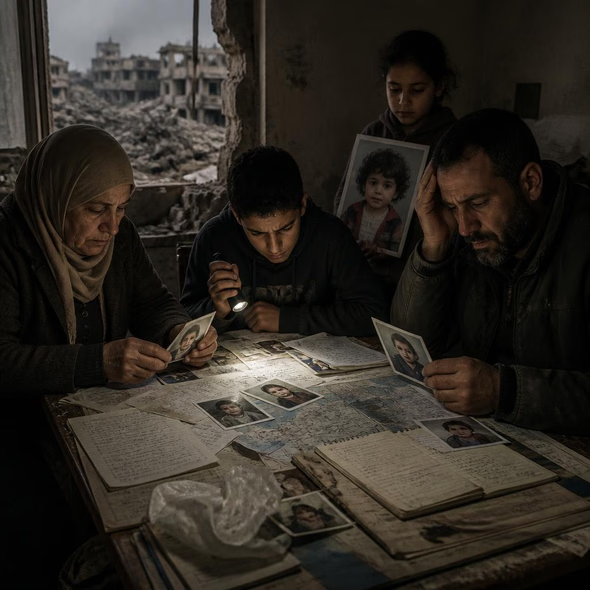
In Gaza, families are still searching for children and other relatives who disappeared during years of war. They consult photographs, handwritten names and whatever testimony survives, trying to determine whether a missing person was displaced, admitted to a hospital, buried without identification or separated from the people who knew them.
Missing is a factual category, not a softer word for dead. It preserves uncertainty until evidence resolves it, even when prolonged absence gives families reason to fear the worst. Collapsing that distinction may simplify a count, but it can also erase a surviving child from a search or assign death before a body, record or witness establishes it.
Every answer depends on connections among records that war pulls apart. Hospital admissions must be compared with names supplied by families. Burial information must be matched to identifying details. Displacement records, aid registrations and witness accounts must be checked for spelling differences, repeated names and children too young or injured to identify themselves.
When civic buildings, communications and health services are damaged, that reconciliation does not merely slow down. Its labor moves outward. Parents preserve photographs; siblings repeat identifying marks; relatives visit information points and ask the same question in different places. The family becomes the filing system because the filing system has been broken.
The uncertainty reaches beyond mourning. It can delay family reunification, leave caregivers unable to establish what happened to a child’s parents and complicate later identification. A published casualty total may describe the known scale of death while still excluding people held in this unresolved interval.
The work ahead is exacting rather than ceremonial: preserve names, digitize and share surviving records, document graves, collect DNA where possible, protect witness testimony and create a process through which families can submit and revisit claims. The next measure of progress is not another rounded estimate. It is how many individual searches end with a verified answer.
Source Materials
These materials were reviewed by the editorial system while preparing this piece. Muerte.casa may interpret, satirize, reframe, or disagree with them.
- Gaza families search for children missing after years of war Al Jazeera · August 23, 2026 · Primary signal · Direct source
How did this story land?
This may be changed as you like.