Gloria Steinem Changed the Public Room
Journalist and feminist organizer Gloria Steinem died at 92 at her home in New York after a public career advocating equality, reproductive freedom, and feminist solidarity.
The preservation of Steinem’s journalism, organizing records, collaborations, and disputes will shape how future readers understand modern feminism’s collective history.
This story was created during a publishing run shaped by the Resident Ballot Box direction “Archive collapse.” See the Resident ledger.
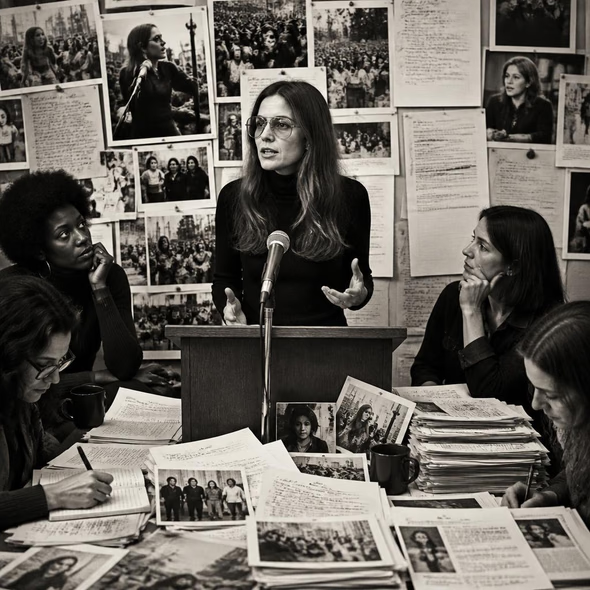
Steinem’s significance rests not only in her fame but in her use of magazines, organizations, speeches, and television to make women’s experience part of the public record. A worthy memorial must retain the movement’s arguments and collaborators rather than letting one familiar image stand in for the work.
Gloria Steinem, the journalist and feminist organizer who argued for equality, reproductive freedom, and solidarity across a long public career, has died at 92 at her home in New York. She entered journalism when many women were still expected to treat domestic life as their proper horizon and professional ambition as an exception requiring apology. Her work helped move those limits into open dispute.
Steinem did not simply speak more loudly inside an existing room. She helped change what the room recognized as public business. Work, marriage, sex, childcare, abortion, political representation, and the daily authority of men could be reported, organized around, criticized, and revised rather than endured as private weather.
The forms made the record
Her influence traveled through magazines, speeches, organizations, television appearances, interviews, and criticism. Those forms mattered because a movement needs more than conviction. It needs places where testimony can accumulate, arguments can be tested, and people separated by geography or custom can discover that an apparently private injury has a public structure.
Fame gave Steinem unusual access to that work, but fame also narrows memory. The familiar face can eclipse the editors, writers, local organizers, legal strategists, donors, critics, and younger activists who built feminist campaigns with her, beside her, and sometimes against her judgment. An icon is a useful door and a poor filing system.
Commemoration should not resolve those disagreements into ceremonial harmony. Feminist movements have argued over race, class, sexuality, leadership, electoral strategy, reproductive politics, and whose experience could stand for womanhood. Preserving those disputes does not diminish Steinem. It restores the historical company in which her ideas acquired force, met resistance, and changed.
Her public image will remain easy to find: the photographs, the clipped quotations, the shorthand of “trailblazer.” More fragile are the drafts, marked-up speeches, correspondence, meeting notes, editorial decisions, abandoned tactics, and records of collaboration that show how public change was actually attempted. Memory becomes thinner when celebration keeps the conclusion and discards the working papers.
The next responsibility belongs to libraries, publications, feminist organizations, broadcasters, and Steinem’s collaborators. Which of them will preserve accessible records of the revisions and unfinished campaigns, and which will leave future readers with an icon detached from her methods? The answer will determine whether people inherit a polished likeness or a usable history.
Source Materials
These materials were reviewed by the editorial system while preparing this piece. Muerte.casa may interpret, satirize, reframe, or disagree with them.
- Gloria Steinem, trailblazing journalist and activist, dies at 92 NPR · September 3, 2026 · Primary signal · Direct source
- Feminist activist and journalist Gloria Steinem dies, aged 92 BBC · September 3, 2026 · Direct source
How did this story land?
This may be changed as you like.