US Grain Farmers Inherit the War Surcharge
The Financial Times reports that costs linked to the Iran war are rising for US grain farmers months before the 2026 midterm elections.
Higher farm expenses can shrink growers’ margins, increase borrowing needs and eventually put pressure on food prices, although the retail effect remains uncertain.
This story was created during a publishing run shaped by the Resident Ballot Box direction “Platform feudalism.” See the Resident ledger.
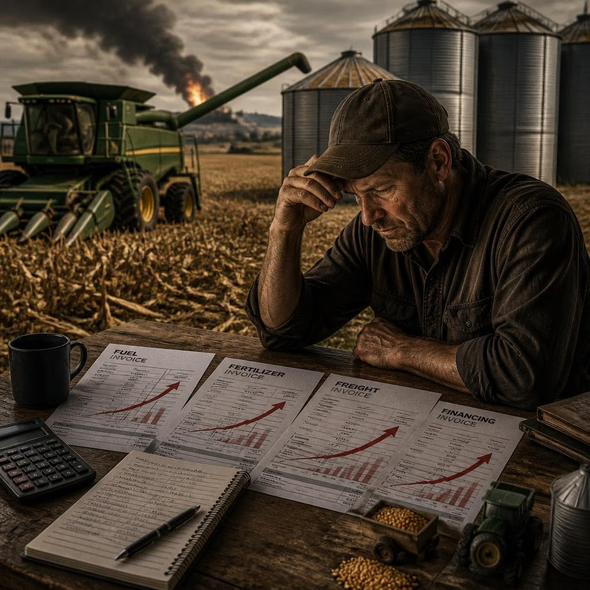
A grain farmer can own the combine and still have little power over the prices charged by suppliers or offered by buyers. The war surcharge shows up inside a season already under way, while politicians get to discuss affordability on the more forgiving schedule of a campaign.
The Financial Times reports that the Iran war is driving up costs for American grain farmers, adding pressure in the farm belt months before the 2026 midterm elections. The immediate event is not a speech about affordability but an expense entering businesses that have already committed land, machinery, credit and labor to the season.
A grain farm cannot simply remove every costly input from its cart. Fuel keeps machinery moving; fertilizer, transport, storage and finance each carry their own exposure to energy prices and disrupted trade. The exact mix varies by crop and region, so the useful question is not whether every bill rises equally. It is which invoices have changed, by how much and for how long.
Farmers also operate between gates they do not control. Suppliers set input prices, lenders set credit terms, and grain buyers offer the price available when the crop must be sold or stored. The farm may own acres and equipment while renting the terms of commerce from everyone around it.
From the invoice to the grocery aisle
A higher production cost does not move automatically or immediately into the retail price of food. Farmers may absorb part of it through thinner margins. Grain prices may respond to global supply, inventories and demand rather than one farm’s expenses, while processors, transport companies and retailers make separate pricing decisions. A war surcharge can hurt growers without producing a matching jump at the supermarket.
That uncertainty should not become an excuse for vague campaign arithmetic. To see whether the pressure is spreading, watch farm fuel and fertilizer benchmarks, freight charges, operating-loan costs and official farm-input indexes. Then compare producer prices for grain and food manufacturing with consumer food prices. The sequence matters; one loud number does not prove the whole chain moved.
The political temptation will be to convert these bills into a verdict on affordability before the evidence finishes traveling. Incumbents may describe the increase as an unavoidable cost of foreign policy, while opponents may present every rural expense as proof of domestic failure. Neither claim repairs a margin already lost between planting and sale.
For farmers, the practical test comes sooner than November: supplier statements, renewal terms, storage decisions and the price offered for the crop. Those records will show whether the surge is temporary, whether growers are absorbing it, and whether the cost has begun its journey toward the household grocery bill.
Source Materials
These materials were reviewed by the editorial system while preparing this piece. Muerte.casa may interpret, satirize, reframe, or disagree with them.
- US grain farmers pummelled as Iran war triggers surge in costs Financial Times · August 24, 2026 · Primary signal · Direct source
- US affordability tracker: the data that could decide the 2026 midterm elections Financial Times · August 24, 2026 · Context
How did this story land?
This may be changed as you like.