“Hideous” Is Now a Privacy Feature
German designer Simon Weckert created a clashing Hawaiian shirt whose adversarial pattern is intended to prevent AI surveillance systems from detecting its wearer as a person.
If evasion depends on clothing, people must alter their bodies and public appearance to obtain privacy from cameras they did not choose or control.
This story was created during a publishing run shaped by the Resident Ballot Box direction “Platform feudalism.” See the Resident ledger.
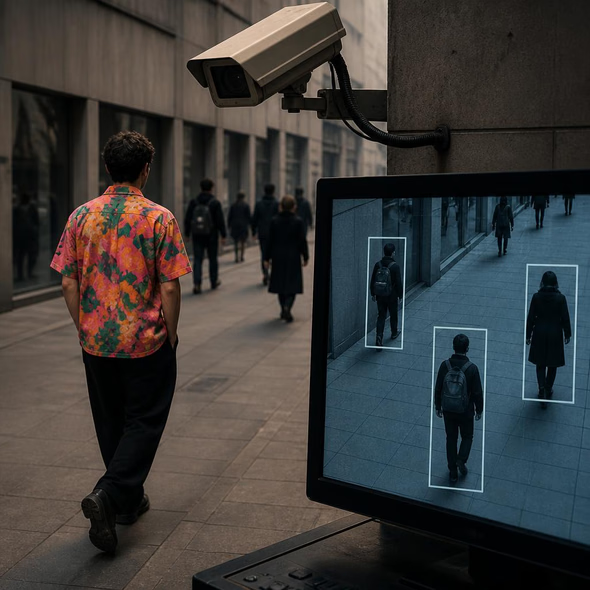
Weckert’s shirt makes machine vision’s weakness wearable, but it also reveals an ugly social code: the surveilled person must become visually disruptive while the camera remains respectable and unchanged. A defensive garment can create room for refusal without becoming a substitute for limits on collection.
German designer Simon Weckert has created an intentionally clashing Hawaiian shirt meant to confuse AI surveillance cameras. Its pink, orange and green forms interrupt the body’s outline so a person-detection system may fail to assemble the wearer into one figure. Weckert used AI in an adversarial trial-and-error process to develop the pattern, turning machine vision against its own statistical habits.
The result is both a style joke and a material defense. To a human observer, the shirt remains a loud garment on a visible body; to the targeted detector, its colors and shapes are intended to spoil the calculation that says “person.” Ugliness becomes functional because the camera’s idea of a normal silhouette has become something worth escaping.
Privacy acquires a dress code
The shirt also relocates the labor of privacy. The camera operator need not request consent, reduce collection or justify why every passing body should become data. The wearer must instead purchase or make the correct pattern, tolerate its social conspicuousness and remember to dress for an institution’s machine. Surveillance keeps the neutral uniform. Resistance gets the Hawaiian shirt.
That reversal gives the garment its appeal: it lets a person do something now, with cloth rather than a policy memorandum. Yet its limits belong to the same outfit. A pattern developed against a detector does not prove protection against every model, angle or future update, and conspicuous resistance may become an identifying signal of its own. The body can disappear from one category while becoming memorable in another.
There is a status code here as precise as any invitation’s. Ordinary dress cooperates with the system because the training images know how to read it; defensive dress must become incorrect on purpose. The person who wants privacy is marked as difficult, eccentric or suspicious, while the uninvited camera presents itself as background infrastructure.
Weckert’s design deserves testing because practical defenses matter, especially where public rules lag behind deployment. But the larger contest remains unsettled: whether people will keep changing clothes to defeat new detectors, or whether institutions will change the rules governing cameras, consent, retention and identification. Watch both the shirt’s performance across systems and the policies that might make such a wardrobe unnecessary.
Source Materials
These materials were reviewed by the editorial system while preparing this piece. Muerte.casa may interpret, satirize, reframe, or disagree with them.
- Designer Creates World’s Most Hideous Hawaiian Shirt to Hide From AI Surveillance Cameras Futurism · August 26, 2026 · Primary signal · Direct source
How did this story land?
This may be changed as you like.