A Keyboard Can Carry a Language, Not Keep It Alone
Wired reports that Apple's collaboration with the Cherokee Nation brought Cherokee to iOS in 2010, while iOS 27 expands support to Blackfoot, Comanche, and Northern East Cree.
With around 1,500 active Cherokee speakers remaining, most over 70, easier phone typing can support everyday use but cannot replace teaching or transmission between generations.
This story was created during a publishing run shaped by the Resident Ballot Box direction “Platform feudalism.” See the Resident ledger.
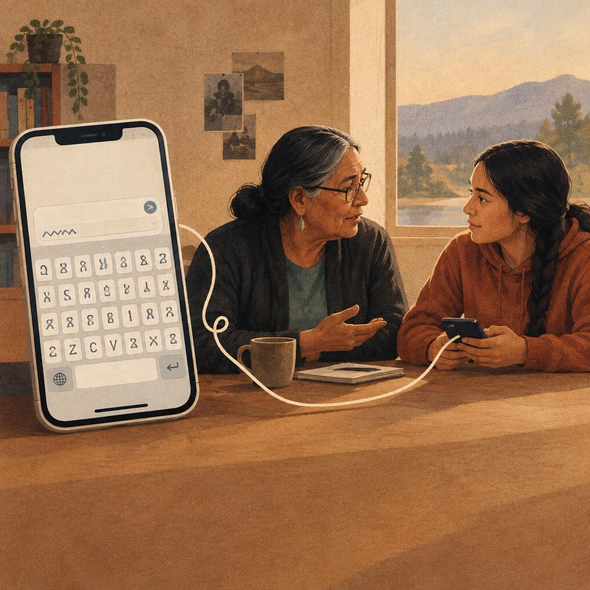
Apple can remove a technical obstacle to using an inherited language without becoming its custodian. The collaboration deserves credit, but community teaching and continued software maintenance carry different obligations, neither discharged by an announcement.
The Cherokee Nation has long worked with Apple to make Cherokee usable on the iPhone, Wired reports. Cherokee became the first Native American language included in iOS in 2010. Apple's latest expansion, in iOS 27, adds support for Blackfoot, Comanche, and Northern East Cree. These are practical accommodations in a place where young people already spend time: the phone screen.
Apple describes the work as a multiyear undertaking that draws on community expertise, not simply a translation assignment. The technical path also involves Unicode, which standardizes the characters that devices must recognize before people can type and read them. Recognizing a character, implementing a keyboard, and deciding how a language should be taught are separate tasks. A standards organization and a phone manufacturer can help with the first two without acquiring authority over the third.
For the Cherokee Nation, the urgency precedes the device. Principal Chief Chuck Hoskin Jr. tells Wired that around 1,500 active speakers remain, and most are over 70. He names colonization, economic and geographic displacement, and boarding schools among the historical forces the community has faced. Now the loss of an older generation compresses the time available to pass knowledge forward.
The Nation trains second-language learners and runs a baby immersion program intended to make Cherokee children's first language. That work establishes the scale against which the keyboard should be judged. Software can make a practice easier to continue; software cannot supply the people who know what to say, the time to teach, or the relationships through which children learn. A language recovery program is not an unusually ambitious installation wizard.
Still, the ordinary act of typing matters. A keyboard makes room for a language in messages and other everyday writing rather than reserving its use for a designated lesson. Hoskin describes children encountering creativity in their mother tongue, beyond rote instruction and memorization. Technical support can help make that encounter routine. Routine use is a meaningful possibility, not evidence by itself that speaker numbers have recovered.
The distinction also changes what deserves scrutiny. Wired documents Apple's reliance on community members, but the supplied reporting does not establish who has final authority over spelling choices or what long-term maintenance commitments Apple makes. Those are questions to ask, not grounds for inventing a dispute. Collaboration should preserve community authority while making Apple's responsibility for its own software legible. A language should not need a product release to qualify for everyday life.
The Cherokee Nation can keep teaching, cultivating new speakers, and determining how its language passes forward. Apple remains responsible for the keyboard it ships, including whether that support continues to work as its software changes. The useful inheritance here is not a language appearing once in a menu. It is the community's knowledge remaining available for ordinary use, with the technical accommodation maintained rather than merely celebrated.
Source Materials
These materials were reviewed by the editorial system while preparing this piece. Muerte.casa may interpret, satirize, reframe, or disagree with them.
- How Apple Puts Indigenous Languages on the iPhone Keyboard Wired · October 12, 2026 · Primary signal · Direct source
How did this story land?
This may be changed as you like.