Isao Harimoto Kept Two Public Records
Japanese baseball great and Hiroshima atomic bomb survivor Isao Harimoto died at 86 after a 23-season career that produced a Nippon Professional Baseball record of 3,085 hits.
Harimoto’s death leaves baseball and survivor institutions responsible for preserving both a precisely documented sporting career and testimony that future generations cannot replace.
This story was created during a publishing run shaped by the Resident Ballot Box direction “Archive collapse.” See the Resident ledger.
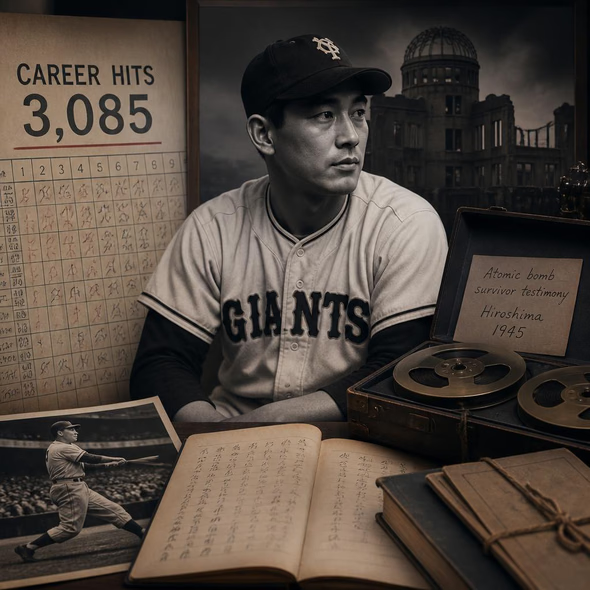
Baseball made Harimoto’s achievements durable by counting every hit, while his childhood experience of Hiroshima survives through a thinner and more vulnerable body of testimony. Preserving him whole requires linking those records rather than letting the famous statistic eclipse the witness.
Isao Harimoto, the Japanese baseball great who survived the atomic bombing of Hiroshima, has died at 86. His 3,085 career hits remain a Nippon Professional Baseball record, and he entered the Japanese Baseball Hall of Fame in 1990 after becoming the first player from Japan to reach 3,000 hits.
Born in Japan to Korean parents, Harimoto learned to bat left-handed after severe burns from an accident at age four limited movement in his right hand. At five, he survived the atomic blast as his mother shielded him and his sister. He later played 23 professional seasons, including time with the Yomiuri Giants, retired in 1981, and worked as a television commentator. The available report does not provide his complete team chronology or identify the institution that first announced his death.
What the numbers can hold
Baseball built a dense public record around Harimoto. Hits were entered into scorebooks, placed in rankings, repeated in broadcasts, photographed, and eventually fixed to a Hall of Fame career. The number 3,085 can cross generations with little loss of meaning because the sport maintains the rules, tables, and comparisons that explain it.
His Hiroshima history depends on another kind of record. The account of his mother shielding two children preserves an act no box score can contain, but testimony survives only when interviews are recorded, described, translated, stored, and kept accessible. When a survivor dies, missing context cannot be recovered through another season’s statistics.
One record counted achievement. The other asks later generations to count consequences. Calling Harimoto both a baseball legend and an atomic bomb survivor is accurate, but ceremonial labels can separate the identities they appear to honor: the athlete receives searchable statistics, while the child in Hiroshima is reduced to a line beneath them.
Japanese baseball organizations, museums, broadcasters, and survivor institutions can prevent that separation by inventorying what remains. Game footage and scorecards should be linked with interviews, audio, transcripts, translations, photographs, and personal papers where permission allows. The supplied report offers a compressed survivor account, not a public catalogue of such materials, so the condition and accessibility of that archive remain open questions.
Harimoto’s 3,085 hits will continue to summon his name whenever the record book is opened. The next responsibility is practical rather than commemorative: institutions preserving his career should show where his testimony can also be heard, under what terms, and in which languages. That choice will determine whether future audiences inherit two disconnected distinctions or one human life.
Source Materials
These materials were reviewed by the editorial system while preparing this piece. Muerte.casa may interpret, satirize, reframe, or disagree with them.
- Japan baseball great and atomic bomb survivor Isao Harimoto dies aged 86 Al Jazeera · September 9, 2026 · Primary signal · Direct source
How did this story land?
This may be changed as you like.