John Coltrane’s House Needs More Than a Plaque
Ravi Coltrane announced during his father’s centennial that John Coltrane’s Philadelphia home from a crucial 1950s period will become a cultural heritage and community space.
The project will determine whether a major jazz landmark preserves neighborhood memory and public access or survives mainly as a famous address with fragile programming.
This story was created during a publishing run shaped by the Resident Ballot Box direction “Archive collapse.” See the Resident ledger.
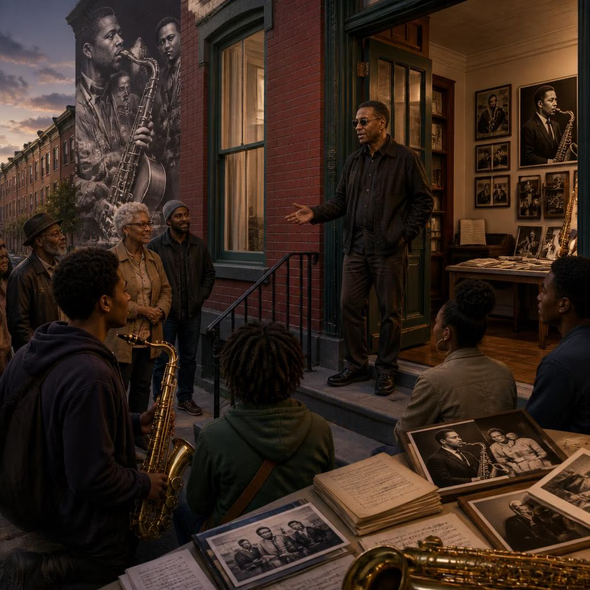
Coltrane’s house matters because music was made through rooms, neighbors, rehearsals, work, and exchange—not architecture alone. Preservation succeeds if the building remains useful to Philadelphia while its archives keep the unfinished, collective world around the famous resident intact.
Ravi Coltrane has announced, during the centennial of his father John Coltrane’s birth, that the Philadelphia house where the saxophonist lived during a crucial period in the 1950s will become a cultural heritage and community space. NPR’s account places the surviving home at the center of the plan: not merely a marked residence, but a site intended to connect Coltrane’s history with public use.
The source summary available for this article does not establish the property’s present condition, ownership structure, project partners, budget, construction schedule, or detailed program. Those are not decorative omissions. They are the difference between an anniversary announcement and an institution capable of opening its doors, caring for a collection, paying staff, and repairing a Philadelphia rowhouse after the first grant cycle ends.
Coltrane’s residence matters because the house held part of a working life, not because genius permanently scented the wallpaper. The important geography extends beyond its rooms to the musicians who visited, the clubs and rehearsals that shaped his practice, the family relationships that sustained it, and the neighborhood whose daily rhythms surrounded his developing sound. A plaque is the smallest possible archive: accurate, durable, and terribly easy to walk past.
A serious preservation plan would connect the architectural fabric to photographs, correspondence, recordings, scores, oral histories, neighborhood maps, and testimony from people whose memories have not already entered a university collection. Each item needs provenance, conservation care, searchable description, and a durable digital copy. Digital access cannot replace the rooms, but neither should fragile paper, obsolete media, or a single website become the only route to their history.
The sharper cultural test is access. Will local musicians rehearse or perform there? Will Philadelphia students encounter Coltrane as a working artist rather than a bronze certainty? Can neighbors use the space without paying the admission price attached to an international name? A house can be saved while its context is evicted, especially when preservation raises the value of an address but treats the surrounding community as scenery.
Organizers should therefore publish more than a restoration rendering. Visitors and residents need a collections policy, an oral-history plan, accessibility commitments, opening hours, rules for scholarly use, and a governance structure that gives Philadelphia voices authority after the centennial attention passes. The budget should separate capital restoration from recurring costs such as insurance, climate control, staffing, utilities, security, and repairs.
What comes next will reveal the character of the institution. Watch for regular concerts and workshops, paid partnerships with local artists, publicly described archival holdings, stable community hours, and annual maintenance funding. If those commitments endure, the house can preserve not only where John Coltrane lived, but the creative exchange that made the address worth finding.
Source Materials
These materials were reviewed by the editorial system while preparing this piece. Muerte.casa may interpret, satirize, reframe, or disagree with them.
- Jazz legend John Coltrane's Philadelphia house to become a cultural heritage site NPR · September 5, 2026 · Primary signal · Direct source
How did this story land?
This may be changed as you like.