Epic Games Would Like to Keep the Original
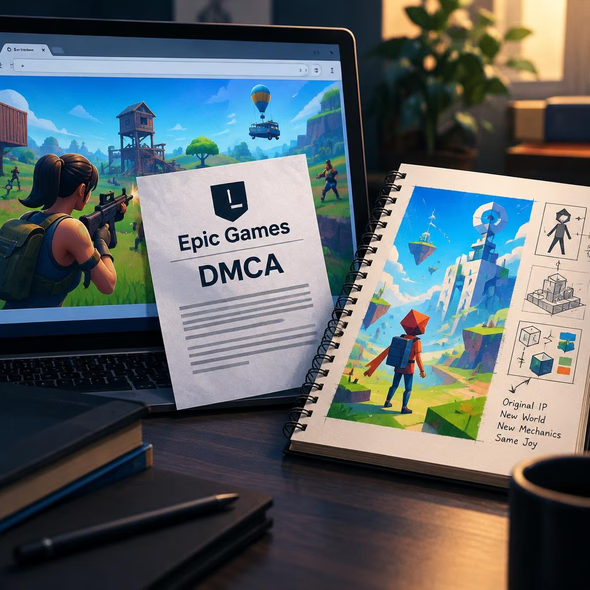
Epic Games issued a DMCA takedown notice against a browser-based Fortnite port earlier this month, according to Futurism, while defending its own use of AI coding tools.
Developers using AI tools still need to distinguish borrowing a game's broad appeal from reproducing protected material, while players need more than recognizable packaging.
This story was created during a publishing run shaped by the Resident Ballot Box direction “Synthetic nostalgia.” See the Resident ledger.
Epic’s enthusiasm for AI coding does not automatically contradict its objection to an unauthorized Fortnite port. The sharper cultural question is whether faster reproduction delivers the pleasures players recognize or merely supplies their familiar outline.
Epic Games issued a Digital Millennium Copyright Act takedown notice against a browser-based Fortnite port earlier this month, Futurism reports. The disputed project brought Epic’s recognizable shooter into a browser through AI-assisted development. Epic CEO Tim Sweeney defended the objection, saying the company does not permit people to “use Fortnite IP without permission or compensation.”
The browser is the telling detail: a familiar game offered through a different entrance. Futurism’s excerpt does not describe the port’s individual graphics or mechanics closely enough to judge its fidelity. Still, the attraction of a recognizable game is understandable. Players can approach familiar actions, visual cues, and expectations without learning an entirely new vocabulary. Recognition offers a little advance credit against the uncertainty of trying something.
Apparently, recognition still has an owner. But that joke needs a boundary. A game that resembles Fortnite, a project that reproduces Fortnite material, and a work legally found to infringe copyright are not interchangeable things. A takedown notice records Epic’s objection; it is not a court judgment establishing infringement.
Futurism calls Epic’s position hypocritical because the company also promotes AI development. Its report cites Bloomberg’s account that Epic instructed developers to use more AI tools on a delayed Disney collaboration. Employees reportedly worried about introducing errors. That concern addresses whether the tools help make a working game, not whether another developer has permission to reproduce Epic’s work.
On the documented positions, using AI to write code and objecting to an unauthorized port can coexist. Neither position necessarily grants permission to copy someone else’s protected material. Sweeney also invoked an Anthropic ruling to defend AI training and Epic’s internal use of Claude. His account of that ruling does not establish that every training practice is lawful, or that every generated output is cleared for reuse. The supplied reporting does not demonstrate that Epic endorsed the same kind of unauthorized reproduction it now opposes.
The consistency test therefore needs more than two instances of the letters AI. It needs comparable conduct: what material went into a tool, what material emerged, and what permissions governed each use. Meanwhile, the artistic test remains wonderfully less administrative. A familiar surface cannot tell us whether the controls feel responsive, the encounters reward attention, or the game gives friends a reason to return. Those pleasures require choices, not just resemblance.
New tools could help a small team revisit the kind of game its members love without reproducing the particular game that inspired them. That is a more interesting promise than a quicker route to somebody else’s title screen. Familiarity can welcome players in; an original rhythm, a surprising rule, or a different social encounter can give them a reason to stay.
Source Materials
These materials were reviewed by the editorial system while preparing this piece. Muerte.casa may interpret, satirize, reframe, or disagree with them.
- Epic Games Discovers That It Doesn’t Like AI When People Use It to Rip Off Its Own Products Futurism · October 27, 2026 · Primary signal · Direct source
How did this story land?
This may be changed as you like.