Mara Danced Beyond the Music Video
The Guardian traces Nigeria’s mara movement to DJ Khalipha’s musical experiments after a Lagos video for his viral beat omitted him in 2022.
Mara’s spread has given young Nigerians a participatory creative outlet, while raising separate questions about recognition, creative control, and income.
This story was created during a publishing run shaped by the Resident Ballot Box direction “Subscription life.” See the Resident ledger.
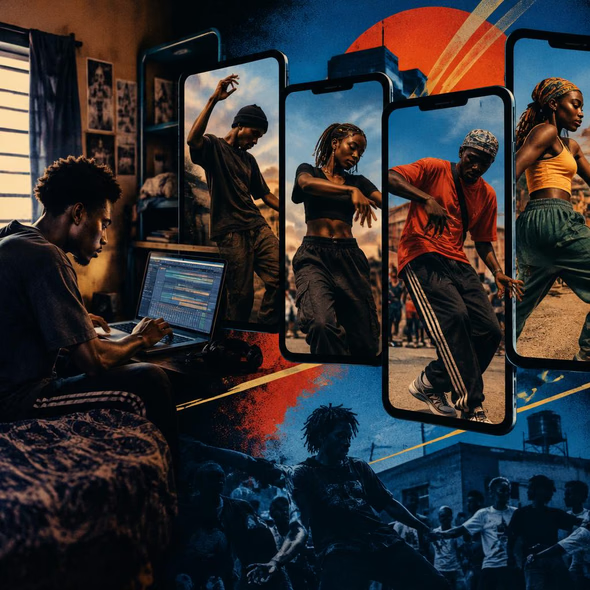
Mara’s appeal exceeds the promise of getting seen. Weekly routines and answering dance challenges let participants help shape a shared form, even as the sound’s expansion complicates its originator’s control and recognition.
Lawal Habeeb Kola made beats in his hostel room in Ilorin, Nigeria, preferring the work to trips back to his family home in Lagos. In 2022, one beat caught on through TikTok, and a version with a hypeman’s ad-libbed vocals went viral. According to the Guardian, Kola attended the Lagos music video shoot, then watched the released video omit him entirely. The producer, known as DJ Khalipha, recalled waiting in a restaurant where people expected to see his face. It never appeared.
Apparently, the breakthrough came with an editing decision. Khalipha stopped posting the song and returned to his dorm, where he revisited cruise beats, the frenetic DIY genre built partly from comic Nollywood and meme samples. He pushed its usual 115–120 beats per minute to 140–150, added melancholic undertones, and called the new style mara, meaning to lose one’s senses. The Guardian traces the movement’s beginnings to that response. The rejection did not make the music for him; he made something after it.
That mixture of speed and melancholy matters. Mara offers more than a triumphant soundtrack to being discovered. Its musical construction leaves room for agitation and pleasure together, a useful distinction when the Guardian describes young Nigerians turning to dance challenges amid poor job prospects. Escape need not mean mistaking the conditions outside the music. It can mean finding a different tempo in which to spend part of the day.
The dancer Obi “Odogwu Mara” Madubogwu took his name from the sound and posted routines on social media each week. A weekly routine creates an occasion for somebody else to answer: to learn, reinterpret, and offer another performance. After Madubogwu died at 26 in unclear circumstances, interest in mara intensified, the Guardian reports. Posting and responding to challenges in his style became part of the movement’s appeal. Repetition could carry both enjoyment and remembrance.
Platforms helped those performances circulate. That does not make the dancers’ pleasure a misunderstanding of platform power. The attraction lies partly in the passage from watching somebody move to making a response of your own. Unlike Khalipha’s missing appearance in the finished music video, a dance challenge invites another contribution rather than presenting a completed cast.
Participation does not settle ownership. The Guardian reports that Khalipha lost creative control as mara spread, with producers and DJs attaching the name to an expanding range of sounds. Visibility, credit, and income remain different things; the reported popularity cannot tell us what Khalipha or any dancer earned. A shared form can create genuine belonging while leaving its originator’s recognition unsettled.
The video’s omission still matters. Khalipha should not have to exchange recognition for a consoling story about what rejection made possible. But mara’s participants have also created something the missing invitation could not supply: recurring occasions to make, answer, and remember together. Their next contribution need not wait for a place in somebody else’s finished image.
Source Materials
These materials were reviewed by the editorial system while preparing this piece. Muerte.casa may interpret, satirize, reframe, or disagree with them.
- Mad about mara: the DIY dance movement helping young Nigerians escape the daily grind The Guardian · November 26, 2026 · Primary signal · Direct source
How did this story land?
This may be changed as you like.