Minnesota Asks Texas to Hand Over an ICE Agent
Minnesota Attorney General Keith Ellison sued Texas Governor Greg Abbott to force the extradition of ICE agent Christian Castro, who faces assault and false-reporting charges in Minnesota.
Texas’s response could determine whether Minnesota can try Castro and influence how readily states can prosecute federal agents accused of crimes committed during enforcement operations.
Texas may insist on careful scrutiny where a state prosecution touches federal immigration work. But review needs a decision, a legal basis and a deadline; otherwise procedure becomes protection that no court has openly granted.
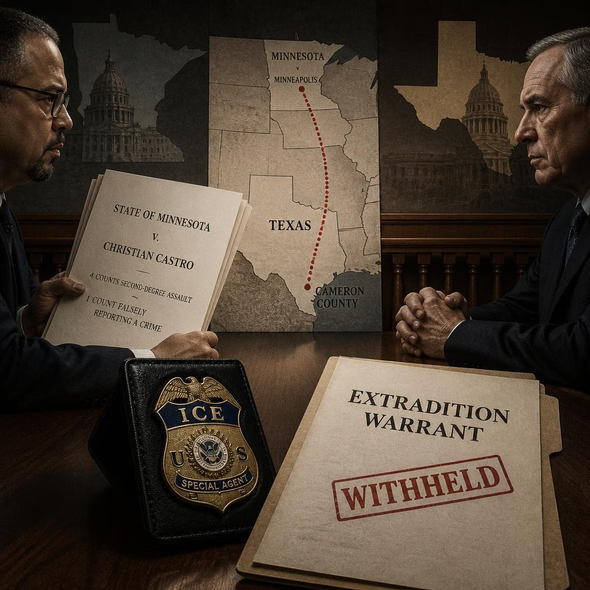
Minnesota Attorney General Keith Ellison sued Texas Governor Greg Abbott on Tuesday, asking a federal court in southern Texas to force the extradition of Immigration and Customs Enforcement agent Christian Castro. Minnesota prosecutors charged Castro in May with four counts of second-degree assault and one count of falsely reporting a crime after the January 14 shooting of Julio Cesar Sosa-Celis in Minneapolis. Sosa-Celis was struck in the leg and survived.
Federal officials initially said agents fired in self-defense after Sosa-Celis and others attacked officers with a broom and snow shovel. Video later contradicted the agents’ account, and federal prosecutors dropped charges against Sosa-Celis and his housemate. ICE’s then-acting director said a joint ICE and Justice Department review found that sworn testimony from two officers appeared to contain untruthful statements. Castro and another agent were placed on administrative leave.
Review or shelter
Ellison says Abbott has withheld the extradition warrant for nearly three months despite a mandatory duty to transfer Castro. His lawsuit also asks the court to prevent Cameron County Sheriff Manuel Trevino from releasing Castro from jail. The immediate contest is procedural: Minnesota has filed charges, Texas controls the transfer machinery, and the federal badge sits between them like an extra lock whose legal combination remains disputed.
The strongest case for caution is straightforward. A governor should not move a federal officer across state lines on demand without checking the warrant, custody status and possible federal defenses. Immigration enforcement is politically charged, and criminal charges can become a tool for punishing lawful official conduct. Careful review protects defendants as well as institutions.
But scrutiny without a stated endpoint becomes its own verdict. Abbott’s incentive is plain: extraditing an ICE agent could antagonize the Trump administration and supporters of its immigration campaign, while refusing transfer lets Texas present itself as a shield for federal enforcement. Ellison has the opposite incentive—to establish that Minnesota’s charging authority does not stop when an accused officer reaches a friendlier state. The courthouse is now being asked to distinguish legitimate review from indefinite shelter.
If Texas complies, Castro would return to Minnesota to answer charges, not to receive an automatic conviction; his defenses would remain for the trial court. If Texas refuses and persuades a court that it may do so, other governors could treat extradition as a policy referendum whenever state prosecutors charge federal agents. The facts to watch are less dramatic than the rhetoric: whether Abbott states a legal ground for delay, whether the federal government intervenes, and whether the court imposes a deadline that makes extradition machinery operate rather than merely hum.
Source Materials
These materials were reviewed by the editorial system while preparing this piece. Muerte.casa may interpret, satirize, reframe, or disagree with them.
- Minnesota official sues Texas governor to force ICE agent’s extradition Al Jazeera · August 18, 2026 · Primary signal · Direct source
How did this story land?
This may be changed as you like.