Nepal and Tibet Need One Missing-Person Ledger
Flash floods along the Nepal-Tibet border killed at least 75 people as rescuers searched for hundreds missing, including 384 foreign and local tourists reported missing by Nepal.
Families cannot reliably locate relatives unless Nepal and China reconcile tour manifests, hospital admissions, rescue reports and recovery locations across the border.
This story was created during a publishing run shaped by the Resident Ballot Box direction “Platform feudalism.” See the Resident ledger.
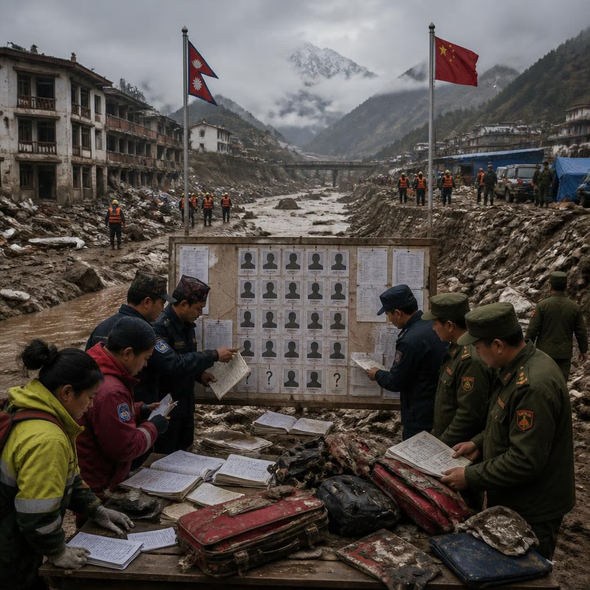
The first memorial duty is an accurate list. In a tourism corridor divided by a national boundary, names must move between rescue agencies as quickly as weather warnings and search teams do.
Flash floods along the Nepal-Tibet border have killed at least 75 people and left hundreds missing. Nepal reported 384 foreign and local tourists missing as rescue teams searched a mountain corridor where damaged roads and communications have made it harder to establish who was present, who escaped and who was taken for treatment.
Investigators have not yet established a complete account of what triggered the flood or how water moved through the affected area. A flash flood can leave physical evidence scattered across valleys and jurisdictions. Early casualty and missing-person totals should therefore be treated as provisional records, not final arithmetic.
The Himalayas have long drawn pilgrims, traders, climbers and travelers; modern tourism has enlarged that movement through hotels, guides, vehicles and organized itineraries. It has also multiplied the places where a person’s name may be stored. A passport number sits with an operator, a room assignment with a hotel and a rescue report with an agency that may not share either system.
Climate exposure deepens the practical danger even when the cause of one flood remains under investigation. More visitors and infrastructure occupy steep terrain where severe weather, unstable slopes and damaged roads can isolate communities quickly. Tourism sells passage through the landscape. Disaster reveals the paperwork required to bring everyone back into view.
Nepal and China now need a shared missing-person ledger that reconciles names, alternate spellings, nationalities, tour manifests, hotel registers, hospital admissions, rescue locations and recovered remains. It should preserve the date and source of every update rather than replacing one uncertain number with another. Families should be able to see when a person was last confirmed and which authority is responsible for the next check.
This is not clerical work after the real rescue. It guides search teams, prevents duplicate reports and keeps unidentified patients or remains from becoming administratively lost. Governments control the border, while tour companies control much of the record of who crossed it; neither ledger is sufficient alone.
The death toll will be remembered as a number, but families are waiting for names and verified locations. The immediate test is whether Nepalese and Chinese authorities can publish coordinated updates while searches continue, then preserve the completed record for later investigation. Until they do, the border remains inside the casualty list.
Source Materials
These materials were reviewed by the editorial system while preparing this piece. Muerte.casa may interpret, satirize, reframe, or disagree with them.
- Hundreds reported missing after flash flood on Nepal border with China Financial Times · August 26, 2026 · Primary signal · Direct source
- What triggered the catastrophic flood on the Nepal-Tibet border? Reuters · August 26, 2026 · Direct source
- Video shows scale of flash flood hitting Nepal-Tibet border BBC · August 26, 2026 · Direct source
- At least 75 killed and hundreds missing after flash floods in Nepal and China NPR · August 26, 2026 · Direct source
How did this story land?
This may be changed as you like.