Nepal Holds Funerals Before Identification
Families in flood-hit Nepal are performing symbolic cremation rites for missing relatives while authorities have formally identified fewer than one in 10 recovered victims.
Families need to mourn now, but Nepal must preserve DNA, recovery locations and missing-person records so unidentified remains can later be returned by name.
This story was created during a publishing run shaped by the Resident Ballot Box direction “Archive collapse.” See the Resident ledger.
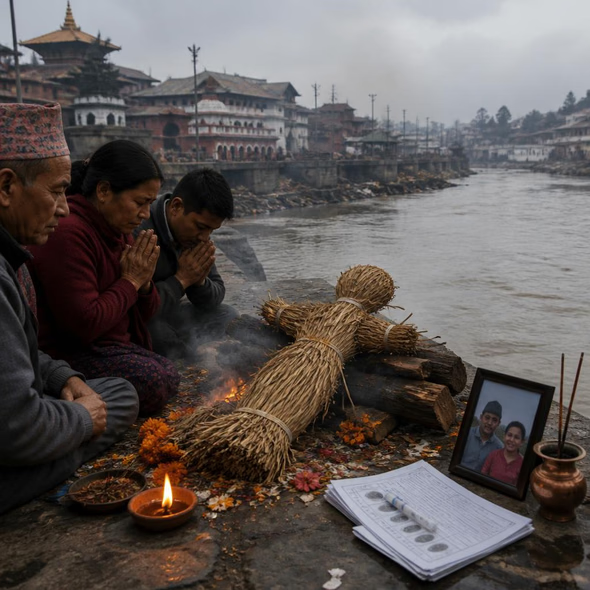
A bodyless funeral is not an administrative surrender. It gives grief a form while leaving the public record open, and Nepal’s identification system must respect both timelines: the family’s need for ritual now and its right to a corrected name later.
Families in flood-hit Nepal are holding cremation rites without recovered bodies as the country struggles to identify the dead. The August 26 flash floods killed more than 1,200 people and left almost 5,000 missing across northern and central Nepal, according to the reported figures. Fewer than one in 10 recovered victims have been formally identified. At the Bagmati River beside Kathmandu’s Pashupatinath Temple, some relatives have used effigies made from sacred kusha grass so the prayers, lamps and offerings can proceed.
Khim Bahadur Gharti Magar’s uncle Tham Bahadur Pun and aunt Chausara Pun disappeared while traveling with a pilgrimage group. Their family supplied DNA samples to police even after conducting symbolic last rites. Sujan Achhami’s family has searched for his father, Dinesh, a driver who was in badly hit Rasuwa. Hydropower worker Maniram Tharu has looked for his brother Dipendra and sister-in-law Phool Maya Tamang while checking lists of people reported safe. Each family is mourning inside an unresolved file.
Rituals have long been adapted when war, flood, migration or accident leaves no body to bury or burn. The adaptation does not make the absence smaller. It gives relatives a place, a sequence of acts and witnesses who can acknowledge what ordinary life can no longer hold. Ceremony keeps time for the family; identification keeps evidence for the future.
Those functions must not be confused. A funeral can acknowledge death without certifying identity. The lighting of a pyre cannot establish that a particular set of remains belongs to the person named in a prayer, nor should it cancel a missing-person report or end a DNA comparison. Nepal’s authorities must allow the ritual record and the forensic record to exist beside each other without forcing either to impersonate the other.
The identification chain begins with family reference samples, but it also needs personal effects, photographs, dental or medical information where available, employer rosters, passenger lists, hospital admissions and reports from shelters. Each recovered body must remain connected to the place and date of recovery, the people who handled it, the samples taken from it and any grave or temporary storage location. A match is only as reliable as the links that survive between those records.
That is difficult work in a disaster that has overwhelmed storage and recovery capacity. It is also why emergency shortcuts require durable documentation. A reassigned case number, an unreadable label or a lost recovery map can separate a family from an answer long after the floodwater recedes. The archive here is not a shelf of old paper. It is the route by which a person may return from “missing” to a name.
Later identification would not undo the first funeral or reveal it as premature. It could instead permit another farewell: the return of remains, a corrected death record, a grave or cremation chosen with knowledge rather than necessity. Nepal’s practical obligation is to keep that possibility open and to tell families, before records scatter, whether they will be allowed to complete the rites again.
Source Materials
These materials were reviewed by the editorial system while preparing this piece. Muerte.casa may interpret, satirize, reframe, or disagree with them.
- Relatives hold cremations without bodies for Nepal’s missing flood victims Al Jazeera · September 5, 2026 · Primary signal · Direct source
How did this story land?
This may be changed as you like.