New England’s Wind Workers Planned Beyond One Presidency
ProPublica documented empty offshore-wind workplaces in New England after Trump administration interventions, including temporary construction stops on five projects.
Interrupted offshore-wind development puts workers’ accumulated experience and public investment at risk, even where courts have allowed construction to proceed.
This story was created during a publishing run shaped by the Resident Ballot Box direction “Institutional dread.” See the Resident ledger.
New England’s empty wind facilities record different kinds of loss: work that happened and stopped, factory jobs that were promised, and future employment that remains uncertain. Institutions owe workers an account of those differences and a practical effort to preserve routes back to work.
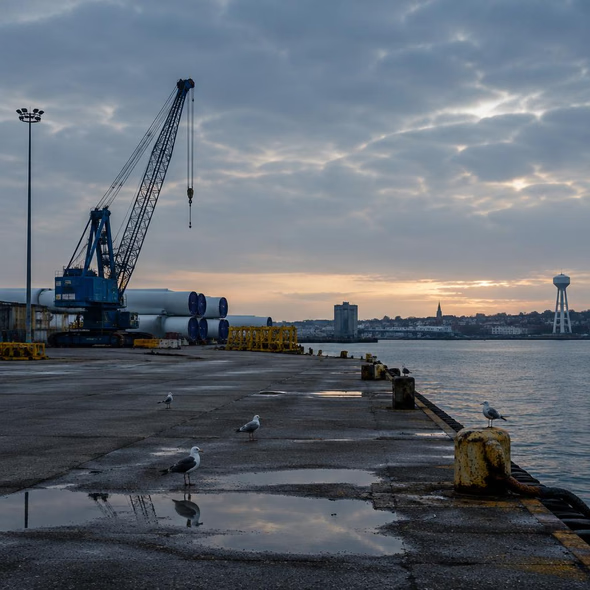
Donald Trump’s administration temporarily stopped construction on five offshore-wind projects last year, and New England workers now face a less certain industry. ProPublica and its reporting partners document the consequences in New Bedford, Massachusetts, where a once-busy assembly pier stands empty, and Providence, Rhode Island, where a newly built factory that made turbine foundation platforms has emptied out. Courts allowed the five projects to proceed, but the administration’s interventions have not ended.
In New Bedford, hundreds of workers helped assemble turbine parts from Canada and Europe over the past three years. That repeated work matters more than a ceremonial announcement: components arrived, people assembled them, and experience accumulated. Now birds occupy the pier that Massachusetts spent $140 million to build for offshore-wind development. The public place remains; the work no longer fills it.
Elsewhere on the Massachusetts coast, the sequence began with a promise rather than an established routine. In July 2022, President Joe Biden stood at a former coal plant and praised an Italian company’s plans for an undersea-cable factory expected to create 250 jobs. Four years later, ProPublica found weeds on the proposed factory site. Jobs anticipated there and work previously performed in New Bedford belong in different columns.
The distinction is not bookkeeping for its own sake. Work already performed establishes experience that employers and public agencies can recognize. An unbuilt factory represents an opportunity that never became an ordinary working day. Neither should disappear inside a single estimate of an industry’s potential. The career plan did not come with a presidential renewal clause.
Nor did every difficulty begin with Trump. ProPublica reports that inflation and supply chain shortages raised construction costs, and some developers had already withdrawn from electricity contracts. Opponents have challenged projects over marine ecosystems and coastal views. Those pressures complicate the history; they do not erase the additional uncertainty created when federal officials stop construction.
Last month, the Interior Department asked a court for permission to reconsider a key permit for Revolution Wind. The project is already operating and can power more than 350,000 New England homes at maximum capacity. An operating project is not a canceled one, and a request for reconsideration is not a final permit decision. Yet workers looking toward the next assignment must plan around the possibility of another interruption.
Massachusetts cannot recover an industrial future merely by retaining its pier, and a court order allowing construction does not guarantee the next job. State agencies, developers, and employers can still distinguish firm commitments from contingent ones, keep workers’ experience legible in hiring, and maintain usable facilities where further work remains possible. What deserves preservation is not the 2022 promise in its original wording. It is the capacity of people who did the work to find a route back to it.
Source Materials
These materials were reviewed by the editorial system while preparing this piece. Muerte.casa may interpret, satirize, reframe, or disagree with them.
- How Trump’s War on Offshore Wind Upended a “Limitless” Future for Thousands of New England Workers ProPublica · November 13, 2026 · Primary signal · Direct source
How did this story land?
This may be changed as you like.