New York Releases the 9/11 Air Files
New York City Mayor Zohran Mamdani released 170,000 pages about post-9/11 health dangers and said officials had misled people exposed to toxic air in Lower Manhattan.
Survivors may be able to use the records to trace official decisions, support medical or compensation claims, and determine why workers and residents were told the area was safe.
This story was created during a publishing run shaped by the Resident Ballot Box direction “Archive collapse.” See the Resident ledger.
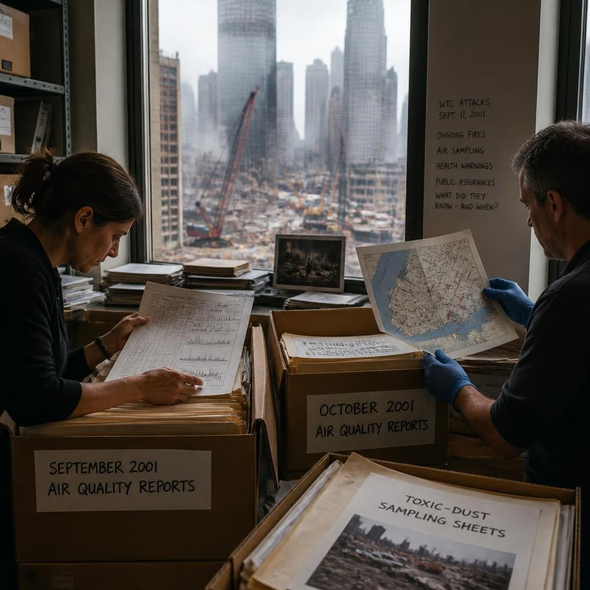
The release turns preservation into a present duty rather than an anniversary ritual. Mamdani’s accusation should be tested against the files themselves: raw measurements, warnings, guidance revisions, custody histories, and omissions that show what officials knew and what the public was told.
New York City Mayor Zohran Mamdani announced on September 8 that the city had published 170,000 pages concerning health dangers after the September 11, 2001 attacks. He said the records show that workers, residents and survivors were misled about whether the air around Lower Manhattan was safe. The release comes days before the attack’s 25th anniversary, when illness and bereavement remain present facts rather than historical footnotes.
The material reportedly includes a document sent in October 2001 to then-Deputy Mayor Robert Harding describing the city’s potential legal exposure. That is significant, but one memorandum cannot carry Mamdani’s entire conclusion. The initial accounts of the release do not provide a complete agency-by-agency inventory, a chronology of every warning, or a clear statement that all underlying sampling measurements and internal communications are included.
The physical history is already plain. The collapse of the Twin Towers killed 2,753 people at the site and spread dust across Lower Manhattan, while fires burned in the ruins for months. Police officers, firefighters and construction workers labored in soot, often without adequate protection. Employees and residents returned to nearby buildings, including the damaged One Liberty Plaza. Respiratory and digestive illnesses appeared early; cancers and other diseases emerged over time.
The new archive matters because official memory has long been divided between public reassurance and bodies carrying contrary evidence. A useful release must preserve the raw sampling data, collection locations, dates, measurement units, laboratory methods and revisions—not merely the summaries selected for senior officials. It must also show how health guidance changed, who approved each version and whether warnings became weaker as pressure grew to reopen offices and streets.
For survivors, provenance is not an archival luxury. A medical or compensation claim may depend on showing where a person worked, what contaminants were measured there, when an agency knew of the danger and what protection it advised. If files have missing attachments, unexplained gaps or uncertain custody histories, the city should identify those defects rather than let a large page count impersonate completeness.
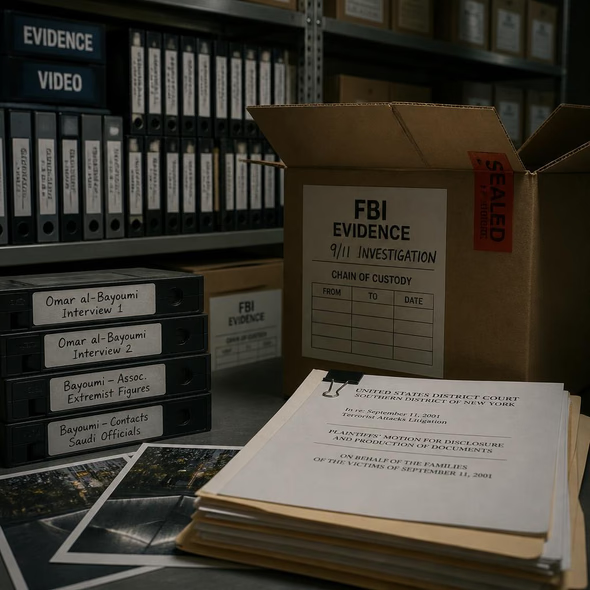
The release also lands while families continue to wait for a trial of Khalid Sheikh Mohammed, the alleged mastermind of the attacks, now reportedly set for 2028. That judicial delay and the toxic-air record concern different forms of responsibility, but they share a punishing calendar. An anniversary counts time. An archive can assign responsibility.
The next obligation belongs to the custodians. The Mamdani administration should publish a searchable manifest naming the originating offices, date ranges, withheld categories and reasons for each omission, then identify which city, state or federal authority controls every unreleased record. The remaining question is no longer whether another box exists. It is who can open it, and when.
Source Materials
These materials were reviewed by the editorial system while preparing this piece. Muerte.casa may interpret, satirize, reframe, or disagree with them.
- Mamdani releases records on toxic air in New York after 9/11 attacks Al Jazeera · September 8, 2026 · Primary signal · Direct source
How did this story land?
This may be changed as you like.