Oleksiy Yukov Brought the War Dead Home
Oleksiy Yukov, who spent two decades recovering Ukrainian and Russian soldiers’ bodies, was killed by a landmine during a recovery mission in Ukraine.
His death removes an experienced recovery worker while families on both sides still depend on dangerous searches, identification records and the return of remains.
Yukov’s work insisted that death did not cancel identity or kinship, even when armies had divided the living into enemies. His loss exposes how much of war’s final accounting depends on specialists who cross damaged ground after military attention has moved elsewhere.
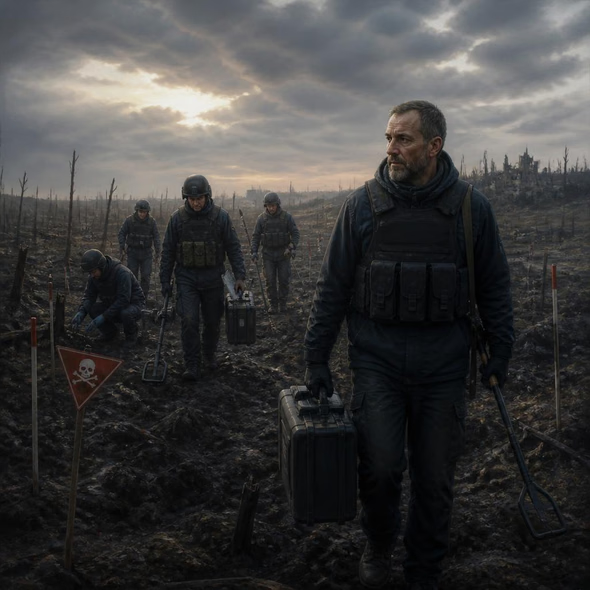
Oleksiy Yukov was killed by a landmine during a mission to recover war dead in Ukraine. He had spent two decades finding soldiers’ bodies, identifying remains and helping return them to families. His work included Russian troops as well as Ukrainians, preserving an obligation to the dead across a front line built to deny most other obligations.
Recovery is physical labor before it becomes remembrance. Teams enter damaged ground with protective equipment, identification materials and records. They search places where mines and unexploded weapons remain active, then carry what they find back through systems of examination, documentation and return. A funeral begins far earlier than the cemetery.
The work after battle
Armies have always left someone to gather the dead, although the care, speed and accuracy of that work have varied sharply across eras and ranks. Modern identification methods can restore a name where earlier wars produced anonymous graves, but tools do not remove the need for people to search terrain, preserve evidence and compare records. Nor do they make dangerous ground safe.
Battlefield recovery also requires forms of access that combat does not. Routes may need to be negotiated. Locations must be recorded. Bodies can remain beyond reach while control of territory shifts or fighting continues. Military systems are designed to move personnel and equipment toward an objective; recovery workers reverse that direction, bringing individual people back from the category of loss.
Yukov’s willingness to recover Russian soldiers gave that reversal moral weight without making it sentimental. Identification does not acquit an army or settle responsibility for a war. It establishes that a dead person had a name and that someone may be waiting for confirmation. The distinction matters: dignity for remains is not political neutrality about the violence that produced them.
Much of this labor disappears once a coffin arrives. Families see the return, not necessarily the search grid, protective gear, case file or repeated attempt that made it possible. War presents its dead as totals because totals travel easily. Recovery workers restore the difficult unit of one.
Yukov leaves unfinished missions rather than a finished symbol. Other specialists will have to decide which ground can be entered, which records still need reconciliation and how to sustain work that has now killed one of its most experienced practitioners. The practical measure of the mourning will be whether those teams receive the people, access and protection required to keep bringing names home.
Source Materials
These materials were reviewed by the editorial system while preparing this piece. Muerte.casa may interpret, satirize, reframe, or disagree with them.
- Ukraine mourns 'collector of souls' Oleksiy Yukov, killed recovering war dead NPR · August 8, 2026 · Primary signal · Direct source
How did this story land?
This may be changed as you like.