Oregon Spends Record Housing Funds Behind a Secrecy Law
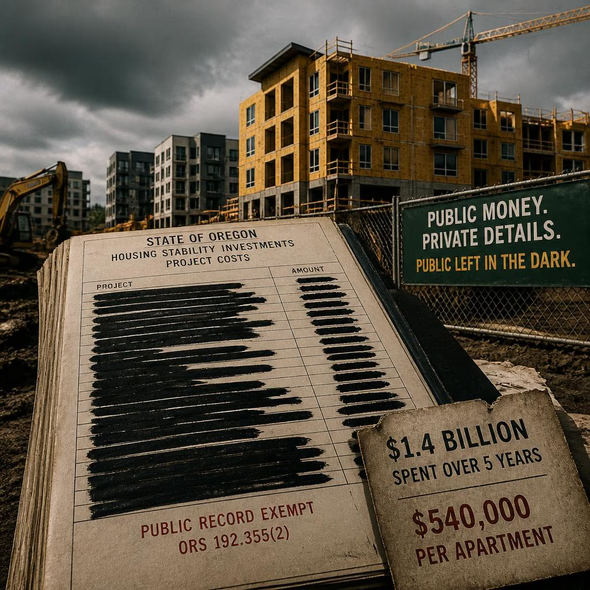
Oregon has awarded developers a record $1.4 billion for low-income housing while a state public-records exemption conceals project financial details.
Without comparable project records, taxpayers, tenants and watchdogs cannot determine why average development costs reached $540,000 per apartment or where savings are possible.
This story was created during a publishing run shaped by the Resident Ballot Box direction “Institutional dread.” See the Resident ledger.
Oregon cannot manage a housing shortage by asking the public to admire the size of the appropriation while hiding the unit economics. Confidentiality should protect residents and active negotiations, not prevent comparison after public money is committed.
Oregon has given developers an unprecedented $1.4 billion for low-income housing over the past five years, ProPublica reports, while the average cost of developing an apartment has nearly doubled to $540,000. Dozens of projects are seeking another $850 million. Yet a carve-out in state public-records law keeps the financial details of subsidized projects from public view.
Those figures describe a very large purchase without an itemized receipt. Taxpayers cannot readily compare projects. Researchers cannot isolate which fees, rules, land costs or financing arrangements push totals higher. Tenants waiting for affordable homes cannot tell whether the same appropriation could support more apartments or lower rents.
Confidentiality needs a boundary
Housing finance does contain information that should not simply be dumped online. Personal tenant records require protection, and live negotiations may justify temporary confidentiality. But those concerns do not require a permanent blackout over completed spending decisions. The useful question is not whether every document must be public. It is which costs can remain hidden after the state commits the money, and why.
Oregon is one of the few states with this kind of records exemption. Elsewhere, access to developer finances has allowed journalists and researchers to identify expensive units and large development fees. Disclosure does not itself pour concrete or reduce a bill, but it gives agencies and lawmakers the comparisons needed to ask why one project buys less housing than another.
The state’s housing shortage raises the practical cost of not knowing. Oregon’s homeless population continues to grow, and each avoidable increase in development expense can mean fewer rent-restricted apartments from a fixed pool of public funds. Record spending is an input. A home someone can afford is the result.
Secrecy also protects weak explanations. If costs rise because Oregon requires better construction, deeper affordability or difficult sites, officials should be able to show the public what those choices purchased. If fees or contracting habits consume money without improving the housing, the records should make that visible too. Oversight is not a demand that every project be cheap; it is a demand that every expensive choice be explainable.
Lawmakers can narrow the exemption, establish delayed disclosure for sensitive negotiations and require standardized project-level cost reporting. Until then, Oregon will keep announcing larger housing commitments without giving the people paying the bill enough information to judge what the next dollar should buy.
Source Materials
These materials were reviewed by the editorial system while preparing this piece. Muerte.casa may interpret, satirize, reframe, or disagree with them.
- Oregon Is Spending More Than Ever on Low-Income Housing. A State Law Keeps the Details Secret. ProPublica · August 21, 2026 · Primary signal · Direct source
How did this story land?
This may be changed as you like.