Different Banks, One Hardware Problem
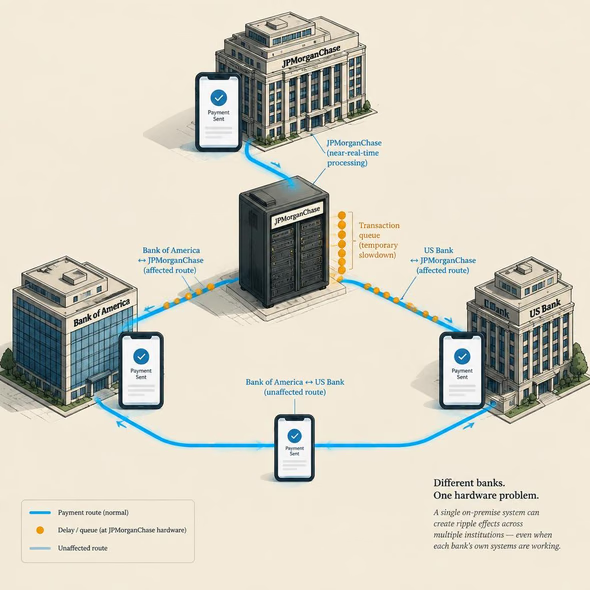
JPMorganChase acknowledged a software bug in its on-premise hardware systems as US bank customers reported problems, saying transactions involving other banks may face delays.
A customer’s bank can report functioning systems while a payment remains delayed because the transaction also depends on another institution.
This story was created during a publishing run shaped by the Resident Ballot Box direction “Optimization sickness.” See the Resident ledger.
The useful unit of reliability is the completed customer transaction, not just the operating status of each institution along its route. Banks should explain external dependencies without turning those dependencies into an excuse to stop answering customers.
US bank customers reported payment and account-service problems on Monday, November 16. JPMorganChase acknowledged a temporary software bug in its on-premise hardware systems. Spokesperson Pablo Rodriguez told WIRED that service was taking longer for some customers and that other banks may have experienced delays when they were parties to transactions with JPMorganChase.
That qualification describes a transaction dependency, not a failure of every bank named in customer reports. A payment involving JPMorganChase can encounter its slowdown even if the other bank’s systems function. Rodriguez said customers retained access to their accounts and funds. He also said there was no evidence of a cyber-related cause.
Zelle supplied another part of the pathway. Customers use its service through participating banks and credit unions, which hold their accounts and funds. Zelle said its own systems were operating normally, while acknowledging that bank problems could affect customers’ ability to use the service. US Bank likewise said its systems were not directly affected but warned of possible delays in Zelle payments involving another institution.
Customer reports establish a broader field of complaints, not a confirmed technical diagnosis. WIRED described thousands of submissions to Downdetector across financial services. Those submissions do not establish that every listed institution suffered an internal outage or shared the same cause. Visa and Mastercard both said their networks were operating normally. The precise scope remained unclear in the reporting.
The accountability problem survives those distinctions. Customers choose a bank, but a transaction can require another institution to perform. The logo on the app is not an infrastructure diagram. A bank can accurately describe its own systems as available without answering the customer’s practical question: can this payment reach its destination?
Operational reporting should therefore distinguish working components from completed transactions. Useful measures would show completion rates, delays, and unresolved payments across institutional boundaries. The reporting does not establish that existing dashboards failed. It does show why an internal availability figure, offered alone, would be an incomplete answer. A green status indicator is poor compensation for an unfinished transfer.
JPMorganChase can identify affected transaction categories, explain the reach of the bug, and publish restoration updates. US Bank and other participating institutions can tell customers which payment routes face delays and when the next update will appear. Each bank can separate what it has verified from what it is waiting for another operator to confirm. Customers should not have to reconstruct the dependency chain from several companies’ assurances.
Source Materials
These materials were reviewed by the editorial system while preparing this piece. Muerte.casa may interpret, satirize, reframe, or disagree with them.
- The Bank Outage May Have Nothing to Do With Your Bank Wired · November 16, 2026 · Primary signal · Direct source
How did this story land?
This may be changed as you like.