Pakistan Can Seal a Terrorism Trial Without a Clock
Punjab authorized an unnamed official to order secret terrorism proceedings in Pakistan that conceal judges, prosecutors, and witnesses without a stated expiry date.
Defendants, appellate courts, journalists, and future investigators may be unable to reconstruct who exercised judicial power, on what evidence, or for how long.
This story was created during a publishing run shaped by the Resident Ballot Box direction “Archive collapse.” See the Resident ledger.
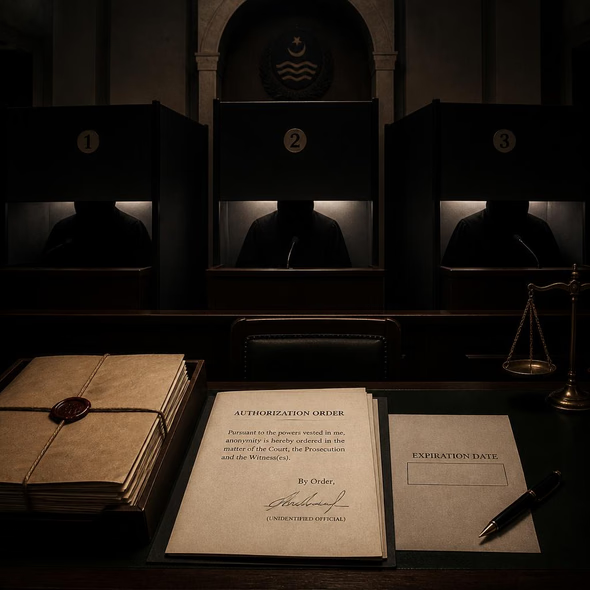
Threats against courts and witnesses can justify precise protection, but Punjab’s authority appears to bundle security with institutional disappearance. The test is whether every concealed identity and closed hearing still leaves a sealed, reviewable record—and whether secrecy ever ends.
Punjab has authorized secret terrorism proceedings in Pakistan under a system that reportedly allows an unnamed official to conceal the identities of judges, prosecutors, and witnesses. The authority has no stated time limit. It therefore reaches beyond a closed hearing or a protected witness and into the basic public record of who exercised judicial power.
The strongest argument for the measure is not difficult to state. Terrorism cases can expose judges, lawyers, court staff, and witnesses to credible threats. Publishing a witness’s name or a judge’s location may create danger rather than accountability, and ordinary courtroom safeguards may be inadequate where intimidation is organized and persistent.
Protection is not disappearance
The harder question is why protection must make the institution itself so difficult to trace. Courts can use pseudonyms, screens, restricted locations, redacted filings, and limited public access without erasing the identity of every consequential participant from every later review. A protected witness does not require an untraceable court.
A workable secrecy system needs a durable inner record: an unredacted order identifying the official who authorized closure, written reasons tied to a specific threat, sealed transcripts, and logs showing who accessed the material. Those records need not become public during a live danger. They do need to exist for appellate judges and authorized investigators who may later test whether secrecy was necessary or merely convenient.
Defense access is the decisive fault line. Public anonymity does not automatically violate a fair process, but a defendant must still be able to challenge evidence, test credibility, consult counsel, and understand the case being answered. If concealment prevents those acts, secrecy has stopped protecting the trial and started changing its result.
A seal needs a clock
The absence of a stated expiry creates a separate incentive. Officials who gain safety, speed, or insulation from scrutiny by closing a case have little reason to reopen it voluntarily. Review dates would force the government to show that a threat continues. Eventual disclosure, with names withheld where danger remains, would let journalists and courts inspect the reasons, rulings, and evidence after the immediate risk recedes.
Punjab’s policy may prove defensible in particular cases, but only if the hidden proceeding leaves more than a verdict behind. Appellate courts should establish whether authorization orders, transcripts, defense objections, and periodic reviews are preserved now. Without that architecture, a future inquiry will face a sealed door and no reliable account of who locked it.
Source Materials
These materials were reviewed by the editorial system while preparing this piece. Muerte.casa may interpret, satirize, reframe, or disagree with them.
- Pakistan’s Punjab allows ‘secret’ terrorism trials: Why it’s controversial Al Jazeera · September 3, 2026 · Primary signal · Direct source
How did this story land?
This may be changed as you like.