Pezeshkian’s Fuel Math Reaches the Pump
President Masoud Pezeshkian’s government is considering higher fuel prices in Iran as food costs rise, the rial weakens and the United States threatens new sanctions.
A fuel increase could raise taxi fares, freight charges and grocery prices while reducing the cost of subsidies carried by Iran’s strained public finances.
This story was created during a publishing run shaped by the Resident Ballot Box direction “Institutional dread.” See the Resident ledger.
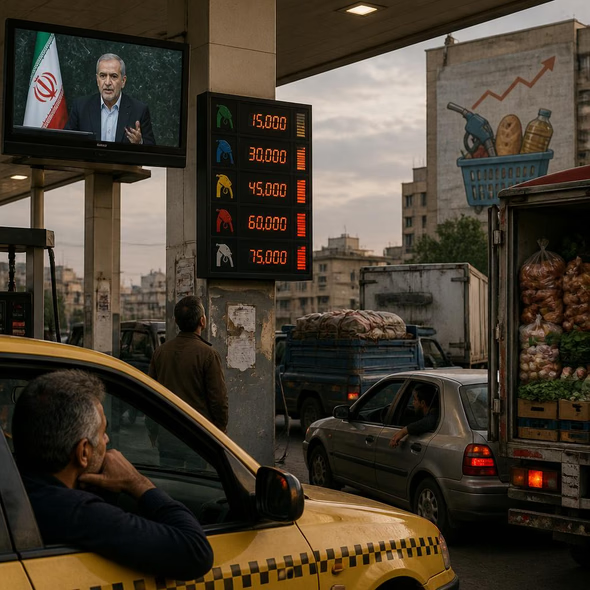
Iran has a real subsidy problem, but the pump is also a distribution system for economic pain. Pezeshkian’s resilience argument will be tested by the compensation, timing and enforcement attached to any increase, not by the government’s ability to describe sacrifice as national policy.
Iran’s government is preparing the public for a possible fuel-price increase while food and other essentials already cost more, the rial has weakened and the United States threatens new sanctions. President Masoud Pezeshkian says Iran has endured war and sanctions without collapsing; a final fuel decision is expected in the coming weeks.
The fiscal case is not imaginary. Iran supplies heavily subsidized petrol to a population of about 93 million, and Pezeshkian says refineries produce a litre at a government cost of 1.3 million rials while the lowest consumer tier sells for 15,000 rials. Other subsidized tiers remain far below the stated production cost, though monthly quotas and fuel cards limit access.
The price does not stop at the nozzle
Changing that bargain would save the state money by charging drivers more. It would also pass through taxis, delivery vehicles, farms and freight. A shop does not need to purchase petrol directly to receive the increase: suppliers add transport costs, workers seek fares or wages they can afford, and groceries arrive carrying part of the pump price.
This is why cheap fuel cannot be judged only as a line in a national ledger. Subsidies can reward heavy users, encourage waste and consume funds that could support other services. But a poorly designed increase can be regressive just as efficiently, especially when households already face rising food prices and a currency that buys less.
Iranian authorities have reason to move carefully. Fuel-price increases helped trigger nationwide demonstrations in 2019, and similar measures preceded protests in January 2026. That history does not settle what the government should charge; it does show that implementation is a public-security decision as well as an economic one. A surprise announcement, confusing tiers or uneven enforcement can turn arithmetic into a queue, then a grievance.
The practical questions now concern compensation, timing and enforcement. Will lower-income households receive support before prices rise or after their budgets absorb the shock? Will taxi and freight operators get separate treatment? Will quotas change, and can drivers understand the new rules before reaching the pump? Pezeshkian can call endurance a national achievement. The price board will identify who is financing its next installment.
Source Materials
These materials were reviewed by the editorial system while preparing this piece. Muerte.casa may interpret, satirize, reframe, or disagree with them.
- Iran government signals fuel price hike on eve of new US sanctions Al Jazeera · August 23, 2026 · Primary signal · Direct source
- Pezeshkian says Iran ‘has not become Venezuela’ despite war and sanctions Al Jazeera · August 23, 2026 · Context
- Iran says new sanctions threatened by 'desperate' US will fail Reuters · August 23, 2026 · Context
How did this story land?
This may be changed as you like.