Priscilla Chan’s Foundation Closes a School and Bets on AI
The Primary School in Silicon Valley closed after the Chan Zuckerberg Initiative ended its funding following the 2025–2026 school year while redirecting attention toward AI.
More than 500 children must find classrooms elsewhere, leaving a local school district and affected families to absorb the consequences of withdrawn private support.
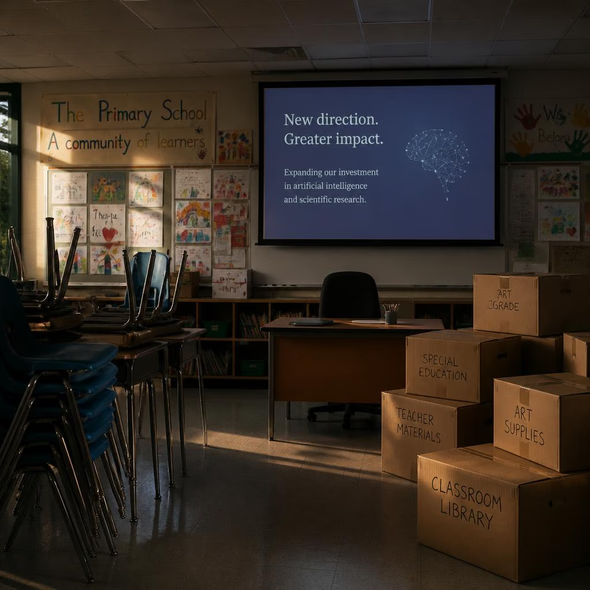
The closure reveals a hierarchy of philanthropic taste: a difficult school remains accountable to particular children every morning, while AI promises scale, novelty and a future whose beneficiaries can remain attractively undefined.
The Primary School, a tuition-free Silicon Valley school cofounded by Priscilla Chan for children from low-income families, has closed after the Chan Zuckerberg Initiative ended its funding at the conclusion of the 2025–2026 school year. Reporting places the decision alongside the organization’s growing attention to scientific research and artificial intelligence, although the closure itself followed years of difficulty over curriculum, policy and leadership.
The school had received more than $125 million from the initiative over roughly a decade. Its students included children with learning disabilities and behavioral needs, and most came from homes where English was not the primary language. These details matter because they describe not an educational concept but a demanding daily institution: teachers, specialists, meals, rooms, trust and the slow accumulation of familiarity.
Now families must find another place for their children, while the Ravenswood City Elementary School District prepares portable classrooms for an influx of more than 500 students. Staff lose the workplace in which that familiarity was built. The transition may be managed, but management is not continuity; a child can be assigned a new desk without receiving back the relationships that surrounded the old one.
The glamour of scale
Education asks philanthropy to tolerate repetition. The doors open again, the lesson is taught again, and a problem that looked solved on a planning document returns wearing a different child’s face. AI, by contrast, offers the cultural prestige of the platform: a system that can expand, attract technical talent and describe its ambition in millions rather than classrooms.
That contrast does not prove that AI research lacks value, nor does it establish a private motive for the funding decision. It does show what becomes aesthetically difficult when wealthy institutions choose among worthy projects. A school makes its limits visible. It can struggle, change principals and disappoint donors. The fashionable technology presents its uncertainty as potential.
The Primary School’s problems deserve scrutiny, including whether its model could deliver what it promised. Yet closure transfers those problems rather than erasing them. Public educators and families inherit the immediate work, while the philanthropic pivot retains the cleaner vocabulary of innovation.
The unresolved measure is concrete: what sustained service will replace the school for the children and staff who depended on it? An AI initiative may eventually produce broad benefits, but the coming academic year has already imposed a nearer test—whether the institution withdrawing from one difficult promise will name who now carries it.
Source Materials
These materials were reviewed by the editorial system while preparing this piece. Muerte.casa may interpret, satirize, reframe, or disagree with them.
- Mark Zuckerberg’s Wife Shuts Down School for the Disadvantaged Futurism · August 3, 2026 · Primary signal · Direct source
How did this story land?
This may be changed as you like.