Private Schools Spend Public Vouchers Behind Closed Doors
ProPublica identified private schools funded heavily or entirely by state vouchers, including 39 Wisconsin schools that enrolled 7,923 children and received about $87 million in the latest school year.
Taxpayers, families and students can bear the cost of weak performance or conflicted governance when voucher-dependent schools receive public funding without public-school disclosure and control.
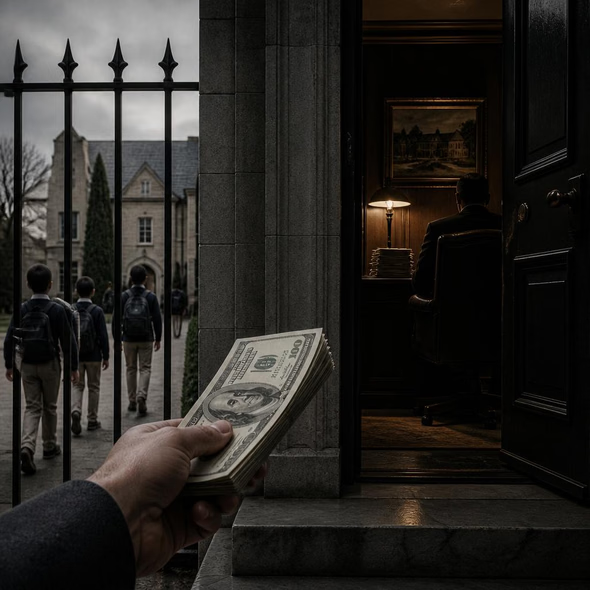
Voucher advocates can plausibly claim that families gain options and schools gain flexibility. But when every student’s tuition depends on the state, privacy stops being a complete answer to demands for scrutiny. The durable question is not whether these schools carry a public label; it is whether public financial dependence will eventually produce public obligations.
ProPublica found private schools where every student receives a publicly funded tuition voucher even though the institutions face little of the accountability attached to traditional public schools. In Wisconsin, 39 such schools enrolled 7,923 children and collected roughly $87 million in vouchers during the most recent school year.
Atlas Preparatory Academy in Milwaukee illustrates the arrangement. ProPublica reports that the K-12 school received more than $4.3 million in voucher money for 357 students despite low test scores and declining enrollment. Its board chair, who also appeared to work as an administrator, received more than $150,000 in compensation in 2024, while his accounting firm received tens of thousands of dollars for accounting and consulting. Wisconsin would prohibit that dual role at a traditional public school, but not at a private one.
The strongest case for the model
Voucher supporters have a coherent argument. Families may want access to a school that fits their academic, religious or disciplinary preferences, including when the local public option disappoints them. Private operators may also adapt faster when they are not bound by every public-school rule. From this view, the voucher belongs to the child, and flexibility is a feature rather than an oversight defect.
That case weakens as public dependence approaches 100 percent. A school financed through every family’s voucher may remain privately governed, but it performs a public financial function. The state supplies the revenue while surrendering many of the ordinary tools used to inspect spending, governance, admissions and results. The arrangement is not simply school choice; it is legislative choice about which obligations money carries.
Why the door stays closed
The incentives currently favor ambiguity. Schools receive a stable public stream without accepting the full public rulebook. Families gain tuition support and may resist requirements that threaten a preferred institution. Lawmakers can advertise expanded options while avoiding direct responsibility for operating the schools. Each participant gets something from the gap between public funding and private control.
The pressure will build around facts that cannot remain ceremonial: independent audits, student outcomes, admissions practices and transactions involving school leaders. Strong results and clean books would fortify the voucher argument. Persistent weak performance, undisclosed conflicts or selective enrollment would make limited oversight harder to defend, especially where taxpayers supply nearly all tuition revenue.
The political durability of these schools therefore depends on which identity prevails when trouble comes. If they are public enough to receive dependable funding but private whenever inspection begins, lawmakers may eventually have to choose between enforcing conditions and defending the exception. What happens first will reveal whether parental choice was designed as an educational policy or as a permanent shield from public review.
Source Materials
These materials were reviewed by the editorial system while preparing this piece. Muerte.casa may interpret, satirize, reframe, or disagree with them.
- At “Quasi-Public” Private Schools, 100% of Students Get Tuition Vouchers. There’s Almost No Accountability. ProPublica · August 17, 2026 · Primary signal · Direct source
How did this story land?
This may be changed as you like.