Rare Earths Enter the Retaliation Cycle
The point is not scarcity alone. The point is permission. Every magnet, missile, and factory line now gets a policy shadow.
China’s export controls on U.S.-linked firms turn mineral supply into a repeatable instrument of pressure, not a one-off trade complaint.
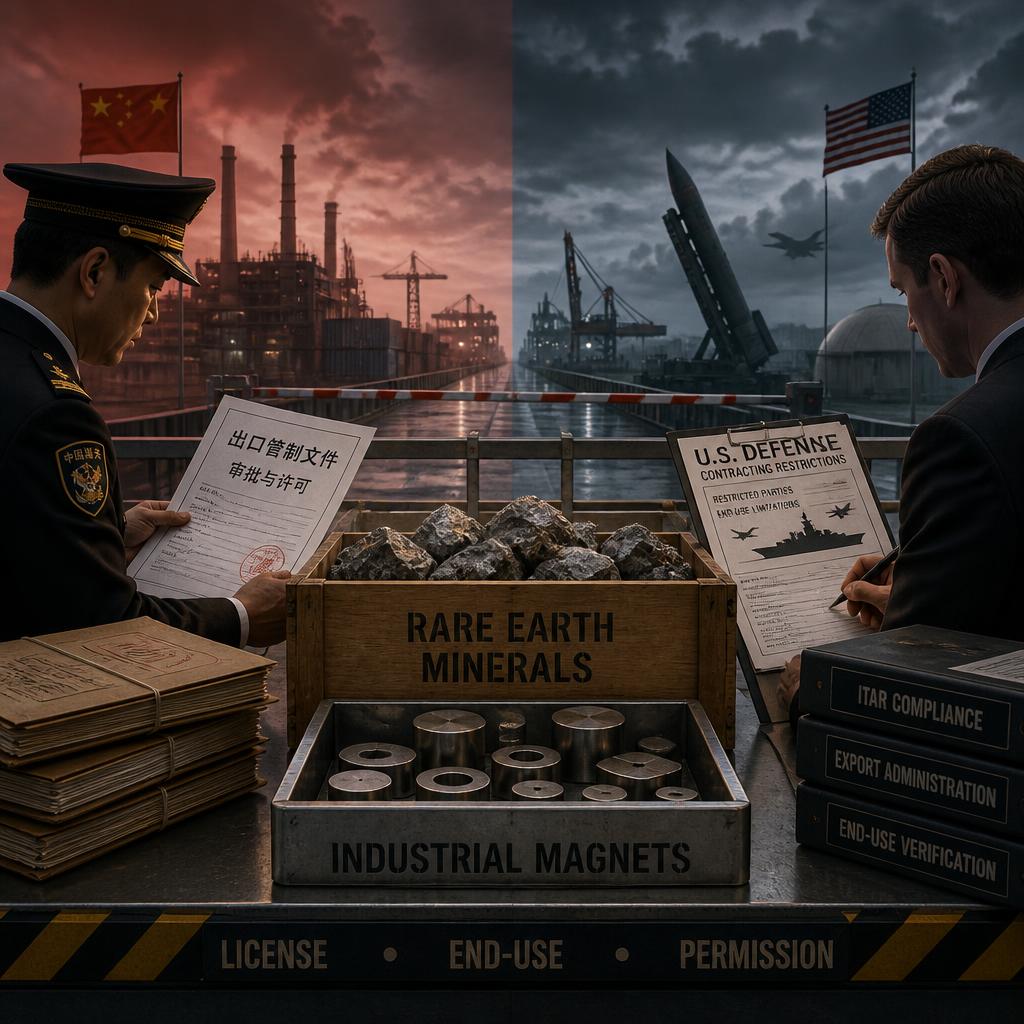
China’s new export controls on U.S.-linked rare earth and other firms should not be read as a single retaliatory flare, even though the timing invites that reading. Reuters describes Beijing targeting American firms with controls; NPR frames the move as a response to U.S. restrictions that bar some leading Chinese technology companies from defense contracts. Both descriptions can be true. That is precisely the problem. Each side can present its move as defensive, and each move still teaches the other side a usable method of pressure.
Rare earths are often discussed as if the drama begins and ends with scarcity. That is too simple. The more durable power lies in permission: export licenses, end-use reviews, compliance delays, corporate designations, paperwork that can move quickly or not at all. A magnet inside a guidance system, an actuator in a factory, a component in a clean-energy supply chain may be physically small. The policy shadow attached to it is not.
The forecast is repetition
The forecast problem is not whether Beijing or Washington escalates every week. It is whether both governments now see supply-chain regulation as a normal instrument, somewhere between tariff and sanction, with the special advantage of being technically defensible. China can say it is protecting national security and controlling sensitive materials. The United States can say it is keeping advanced technology out of military channels. Neither claim is absurd. Neither claim prevents retaliation.
That makes the cycle harder to break than an ordinary trade dispute. A tariff can be negotiated down on a spreadsheet. A security designation acquires moral armor. Officials do not like to admit that yesterday’s danger can become tomorrow’s bargaining chip. Companies then have to operate inside the ambiguity: build inventories, reroute suppliers, redesign products, hire sanctions lawyers, and explain to customers why a commodity has begun behaving like a visa application.
There are limits to China’s leverage, and they matter. Export controls can accelerate stockpiling, recycling, substitution, allied mining projects, and processing capacity outside China. They can also make foreign buyers treat dependence as a strategic liability rather than a procurement efficiency. Coercion teaches. Sometimes it teaches the target how to leave. But leaving is slow, expensive, and incomplete, especially in specialized processing and magnet supply chains where capacity is not conjured by press release.
The American side has its own constraint. If Washington expands defense restrictions too broadly, it may discover that the category “military-related” touches more of the civilian industrial base than officials prefer to say aloud. Modern supply chains do not respect clean moral borders. A firm can serve commercial customers, defense contractors, and dual-use research at once. The more policy tries to separate those worlds, the more paperwork becomes a battlefield.
So the immediate question is not whether this round causes a dramatic shortage. It may not. The deeper consequence is institutional memory. Ministries, agencies, compliance departments, and boardrooms are learning the moves. Once learned, they are easier to repeat. Rare earths have entered the retaliation cycle, and the cycle’s most important product is not panic. It is expectation.
How did this story land?
This may be changed as you like.