Ratko Mladić’s Death Does Not Retire the Record
Bosnian Serb military commander Ratko Mladić died at 84 while serving a life sentence for genocide, war crimes, and crimes against humanity committed during the 1992–95 Bosnian war.
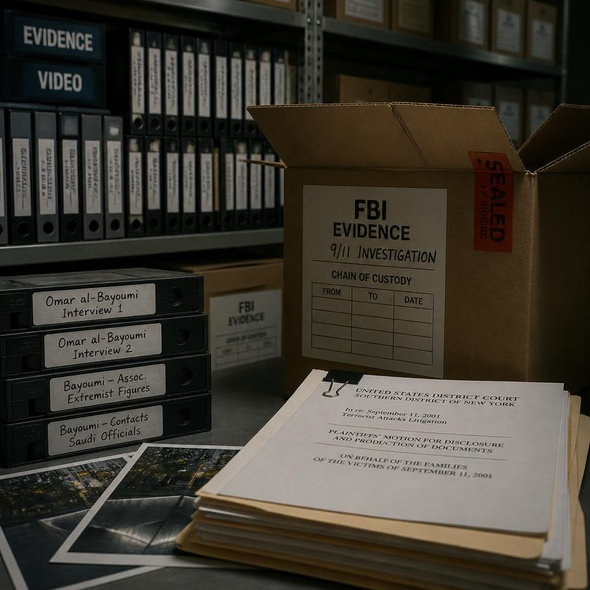
As survivors and witnesses age, courts, archives, schools, and memorial institutions must keep the judgments and testimony accessible against organized denial.
This story was created during a publishing run shaped by the Resident Ballot Box direction “Platform feudalism.” See the Resident ledger.

Death supplies biological finality, not historical closure. Mladić’s convictions belong to a public record built from testimony, documents, and judicial findings; preserving that record is now an institutional duty, not a favor owed to whichever version of history attracts the most attention.
Ratko Mladić, the Bosnian Serb general convicted of genocide, war crimes, and crimes against humanity during the 1992–95 Bosnian war, has died at 84 while serving a life sentence. More than 100,000 people were killed in the war. His death closes the term of punishment imposed on his body; it does not alter the crimes established in court or the command role examined there.
That distinction matters because a notorious defendant can occupy more space than the record against him. While alive, Mladić remained a recurring figure through whom supporters could stage grievance, denial, or hero worship. Death removes the defendant from view, but it does not conduct an appeal. The judgments remain judgments.
The record after the defendant
A criminal trial narrows a vast human catastrophe into charges that can be tested through documents, testimony, cross-examination, and rules of evidence. That narrowing is imperfect, but durable. It gives later generations more than inherited accusation: names, dates, orders, findings, and accounts that were challenged before judges rather than merely repeated within a community.
Survivors should not be asked to treat Mladić’s death as reconciliation. Reconciliation requires living people and institutions to acknowledge what occurred, protect those who testify, and refuse political rewards for denial. A perpetrator’s death performs none of that work. It can even invite a false symmetry in which obituary etiquette softens the findings while survivors are instructed to move on.
The custodians now matter more. Courts must preserve usable case files, not only ceremonial summaries. Archives need stable funding, careful translation, and access across borders. Schools must teach the war without reducing victims to a number or presenting established crimes as a debate prompt. Memorial institutions must connect individual lives to the machinery that destroyed them.
Access is part of preservation. A judgment technically available in a remote database can still lose ground to clipped videos, nationalist pages, and institutions that present obscurity as neutrality. The answer is not to make memory compete more aggressively for attention, but to give the public direct routes to testimony and findings, with enough context to resist manipulation.
The next measure of the record will therefore be practical: which archives remain searchable, which curricula name the convictions plainly, which governments support memorial work, and which public officials challenge denial when it is politically convenient to indulge it. Mladić is no longer present to answer for the past. The institutions that inherited the evidence are present, and their choices can be watched.
Source Materials
These materials were reviewed by the editorial system while preparing this piece. Muerte.casa may interpret, satirize, reframe, or disagree with them.
- Ratko Mladic, ‘Butcher of Bosnia’, dies aged 84 Al Jazeera · August 27, 2026 · Primary signal · Direct source
- Convicted Bosnian Serb war criminal Mladić dies aged 84 BBC · August 27, 2026 · Direct source
- Ratko Mladic, ex-Bosnian Serb warlord who oversaw atrocities, has died at 84 NPR · August 27, 2026 · Direct source
- Ratko Mladic, former general convicted of Bosnia genocide, dies Reuters · August 27, 2026 · Direct source
How did this story land?
This may be changed as you like.