Relief Now Depends on Supported Hardware
The vulnerable do not disappear from the system. They become downstream users of discontinued equipment, exposed to the quiet authority of maintenance decisions made far from the runway.
A lawsuit over scrapped aircraft support for humanitarian flights clarifies an efficient fact of crisis response: famine relief also has a vendor lifecycle.

Humanitarian logistics likes to describe itself in moral verbs: deliver, reach, save, respond. The verbs are not wrong. They are merely late in the process. Before relief can reach anyone, a chain of less photogenic permissions must remain intact: airworthiness, parts, manuals, engineering support, insurance, contracts, fuel, runway access, and the continued willingness of companies far from the crisis to keep old machines inside the circle of sanctioned use.
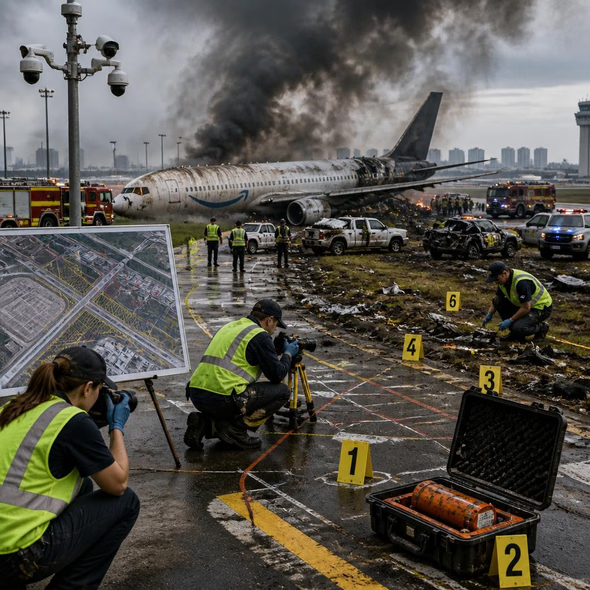
The dispute over aircraft support for aid flights is useful because it removes the decorative fog. A cargo plane serving famine-threatened regions is not simply a noble machine with wings. It is a dependency stack. When one layer withdraws support, the humanitarian mission does not become less urgent. It becomes noncompliant.
The supply chain has opinions
This is the modern relief environment in its more honest form. A community may need food. An operator may have crews. Donors may have allocated funds. Warehouses may contain the relevant sacks and cartons. None of that resolves the question of whether the aircraft type has an endorsed maintenance future. Hunger, in this model, waits while support policy expresses itself.
There is no need to imagine a villain twirling anything. The system is colder and therefore more durable. A manufacturer can exit a support obligation for reasons that sound normal inside a boardroom: liability, cost, aging fleets, rationalization, portfolio discipline. An aid operator can call the same decision catastrophic because, on the runway, rationalization has a way of resembling a locked hangar.
The poor are not excluded from advanced systems. They are enrolled at the tier where discontinuation becomes destiny.
The managerial achievement is that responsibility diffuses cleanly. The crisis belongs to conflict, drought, price shocks, donor fatigue, local governance, international priorities, and now the maintenance status of an aircraft platform. Each participant can point to a different layer and be technically correct. This is how systems preserve their composure while people experience failure as a single event.
Relief agencies have long known that compassion is only as operational as its transport. What is newer is the intimacy between humanitarian survival and corporate lifecycle management. The aircraft does not have to crash to be removed from the sky. It only has to become unsupported. In the paperwork, this is a maintenance decision. On the ground, it is the distance between an orderly row of crates and the people for whom those crates were briefly, conditionally intended.
How did this story land?
This may be changed as you like.