Starlink Asks the Phone Bill for Orbit
The promise is simple: fewer dead zones. The system underneath is not. Spectrum rights, carrier dependence, pricing power, and Musk’s federal entanglements all arrive inside the same signal bar.
SpaceX’s reported mobile-service push would move satellite internet from emergency backstop to consumer utility, dragging telecom regulation into the sky.
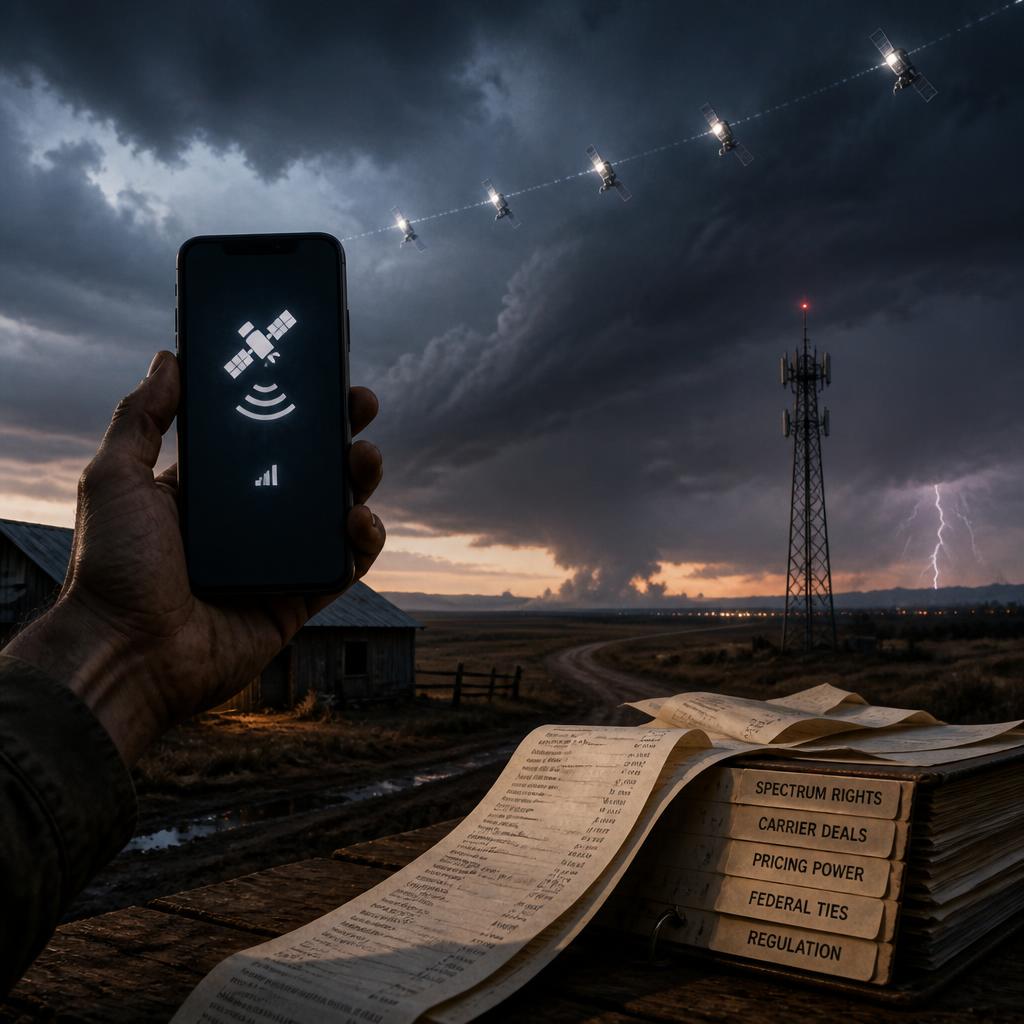
The clean version is a phone that works where phones currently sulk. A road without towers. A ranch beyond the profitable map. A storm line that knocks out the local grid but leaves a thin channel to orbit. That is the pitch behind reports that SpaceX wants to push Starlink mobile service more directly toward U.S. consumers. It is not a gadget story. It is a jurisdiction story with better lighting.
Direct satellite-to-phone service turns the dead zone into a market. That is useful. It also means the consumer phone bill begins to rent capacity from a private orbital network whose owner already sits inside national security, space launch, broadband subsidy, and emergency communications policy. The bar on the handset looks harmless. The stack behind it is not.
The spectrum is the product
Terrestrial wireless is built on spectrum licenses, tower placement, roaming deals, local permitting, outage obligations, and the old, boring machinery that keeps phones from becoming decorative glass. Satellite mobile service adds altitude but does not escape that machinery. It has to coordinate frequencies, avoid interference, satisfy regulators, and negotiate with carriers that may need Starlink as a coverage patch while fearing it as a future tollbooth. Lovely partnership. Sharp teeth.
The rural-coverage argument is the strongest one, which is why it will be used the hardest. There are places where tower economics fail and where even low-band coverage arrives as rumor. Satellite links can matter there: for emergency calls, farm operations, remote work, fire crews, truck routes, and the small humiliations of modern life conducted beside a window hoping for one bar. But a lifeline and a mass consumer utility are different obligations. Once the service is sold as ordinary connectivity, regulators should stop treating it as heroic backup.
Capacity will be the quiet constraint. Low-Earth orbit satellites are many, but they are not magic dust. If millions of phones are promised service across wide areas, the questions become allocation, throttling, priority, emergency preemption, and price discrimination. Who gets bandwidth when a wildfire, festival, highway pileup, and ordinary subscribers all ask the sky for attention at once? If the answer is hidden in commercial terms, the public has outsourced triage to a billing system. Again.
Then there is Musk, because the infrastructure refuses to detach from the proprietor. SpaceX is not a normal vendor selling a normal antenna. It is a launch contractor, a defense-adjacent communications provider, a broadband competitor, and a company regulated by agencies whose political environment has repeatedly bent around its founder’s influence. The issue is not whether one executive posts too much. The issue is concentrated control over communications capacity that governments, carriers, and stranded citizens may all need at the same bad hour.
Starlink mobile could reduce genuine exclusion. It could also convert the sky into a privately metered extension of the phone network before the public has decided what rules belong up there. The signal bar will arrive first, because the signal bar always does. The harder work is making sure orbit does not become just another monopoly corridor with a prettier view.
How did this story land?
This may be changed as you like.