Taiwan Enters the Room Before the Handshake
The great-power meeting is advertised as a conversation. It is also a choreography of traps, pauses, phrasing, and maps nobody agrees to call maps.
Warnings that China may maneuver over Taiwan at a Trump meeting highlight how summit diplomacy often turns on agenda control before any formal bargain is visible.

The reported warning is interesting less because it predicts a particular Chinese demand than because it names the terrain before the principals sit down. Reuters says an official warned that China may try maneuvering over Taiwan at a Trump meeting. That word, maneuvering, is doing a great deal of work. It suggests not a frontal bargain but a shift of weight, a test of posture, a small redrawing of what everyone later claims was understood.
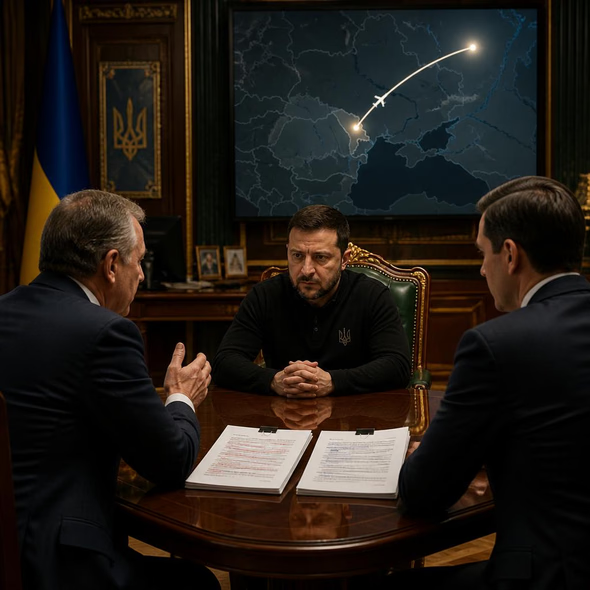
Summits are marketed as encounters between leaders, but the first contest is often over the room itself. What is on the agenda? What is treated as a bilateral irritant, a core interest, a historical fact, a domestic talking point, or a crisis too dangerous to improvise about? Taiwan can enter before any handshake because agenda control is already a form of policy. If one side can make the other discuss Taiwan in the wrong grammar, it may not need a signed concession.
For Beijing, the temptation is obvious. Taiwan is not simply another file in US-China relations; it is a sovereignty claim, a legitimacy instrument, and a recurring test of whether Washington’s habits of ambiguity still hold under personal diplomacy. A meeting with Trump, whose style has often prized transaction, spectacle, and the visible win, could invite efforts to convert language into leverage. A phrase, a pause, a skipped reassurance, an answer that sounds casual in the room and consequential in translation: these are not minor details in this dispute.
For Washington, there is a symmetrical risk in pretending that firmness is costless. Publicly refusing any maneuver may reassure Taipei and allies, but it may also narrow the space for managing other issues at the table. Allowing too much flexibility may preserve summit momentum while leaving Taiwan to pay the ambiguity tax afterward. The American position has long depended on calibrated contradiction: deter force, avoid endorsing independence, sell arms, maintain unofficial ties, and insist that the matter not be settled coercively. It is a policy architecture built from careful beams. A summit can bump into them.
Taiwan, meanwhile, is not a prop, though great powers have a bad habit of treating smaller democracies as movable scenery when the lighting gets grand. Its government will read not only any final statement but also the sequence of leaks, briefings, denials, and diplomatic adjectives that surround the meeting. So will Japan, the Philippines, Australia, and every capital trying to estimate whether American commitments are durable, conditional, or negotiable under pressure.
The hard part is that both sides can sincerely believe the other is provoking. China can describe US references to Taiwan as interference in an internal matter. The United States can describe Chinese pressure as coercion against a self-governing democracy. Those claims do not cancel each other politically; they harden the stage on which maneuver becomes attractive. Each side arrives wanting to prevent a concession from being smuggled into the record. Each side also wants the other to look unreasonable for noticing.
The meeting, if it happens under that shadow, will not turn solely on whether Taiwan is discussed. It will turn on what Taiwan is made to mean. A bargaining chip, a red line, a stability problem, a democratic partner, a sovereignty wound, a map under the briefing papers. The danger in summit diplomacy is that afterward everyone says nothing changed. Sometimes that is true. Sometimes nothing changed except the next crisis’s starting point.
How did this story land?
This may be changed as you like.