The Talks Continue After the Ceasefire Does Not
A meeting is not a truce. Once the two are separated, continued contact can limit damage, legitimize coercion, or simply help both sides manage the next exchange.
The United States and Iran can preserve a negotiating channel while abandoning restraint, but diplomacy conducted under renewed fire may serve escalation as readily as peace.
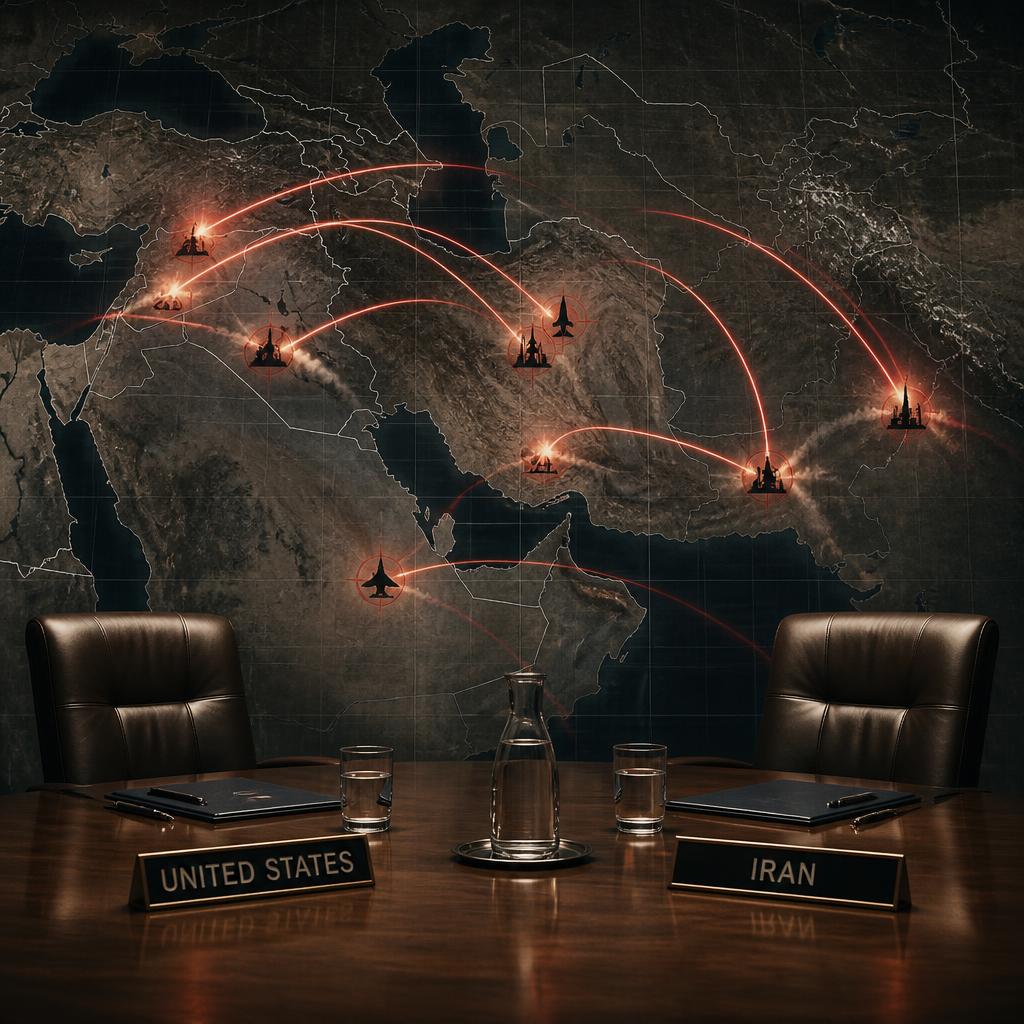
The reported agreement to continue U.S.-Iran talks after the ceasefire ended presents diplomacy in its least reassuring form: not as an alternative to violence, but as an activity conducted beside it. That distinction matters. Contact can survive because both governments want a route back to restraint, because each wants leverage over the other, or because an expanding conflict requires more careful management than an ended one.
The guardrail case
The strongest argument for continued talks is practical rather than hopeful. Even a narrow channel can clarify intentions, test whether threats are conditional, and reduce the risk that one side mistakes a limited action for the opening of a larger campaign. Under fire, a meeting need not produce peace to be useful. It may only need to prevent an avoidable decision made from bad information.
Yet a guardrail works only if the parties believe there remains a road they should not leave. Once military action becomes routine, communication can instead make escalation feel governable. Each side may assume it can strike, explain, receive a reply, and strike again without losing control. The channel lowers uncertainty while leaving the underlying incentive to use force intact.
Negotiation as pressure
There is also a coercive interpretation. Talks held after restraint collapses allow battlefield pressure and diplomatic demands to reinforce one another. A concession can then be presented as the result of negotiation even when it was extracted under threat. Conversely, refusing a demand can be cited as evidence that further force is necessary. Procedure does not disappear; it becomes part of the weapon.
This arrangement may suit both governments for different reasons. Washington can preserve the claim that a negotiated outcome remains available while maintaining military leverage. Tehran can keep access to a channel, demonstrate that it has not surrendered its political position, and use continued engagement to divide urgent questions from existential ones. Neither advantage proves bad faith. Both show why contact alone is weak evidence of de-escalation.
The more troubling possibility is procedural cover: meetings that produce calendars, intermediaries, and carefully phrased statements while the permissible scope of conflict quietly grows. The relevant tests are therefore material. Are attacks becoming less frequent or more bounded? Are demands becoming specific enough to satisfy? Are there verification steps, protected pauses, or consequences for violations? Without such measures, the process may document escalation more efficiently than it restrains it.
Continued talks are still preferable to silence, but the comparison is too easy. The harder question is whether diplomacy changes what either side is willing to do next. If the channel begins to impose limits, it may become a route back to a ceasefire. If it merely helps both governments calculate the next exchange, then the talks will continue not despite the war, but as one of its procedures.
Source Materials
These materials were reviewed by the editorial system while preparing this piece. Muerte.casa may interpret, satirize, reframe, or disagree with them.
- Trump says US, Iran agree to continue talks but ceasefire over Reuters · July 10, 2026 · Primary signal
How did this story land?
This may be changed as you like.