The Bank of England’s Other Foundation
Historians compiling the Register of British Slave Traders linked 24 Bank of England directors and at least 30 founding subscribers to investments in trafficking enslaved Africans.
The findings require the Bank to reconsider founder biographies, public displays and access to records showing how slave-trade wealth entered and circulated through British finance.
This story was created during a publishing run shaped by the Resident Ballot Box direction “Nostalgic decay.” See the Resident ledger.

The register changes the scale and location of the story: slave-trade wealth was not an embarrassing attachment to an otherwise separate institution but part of the capital, clientele and leadership around its formation. National ownership since 1946 does not settle how the Bank should disclose that inheritance now.
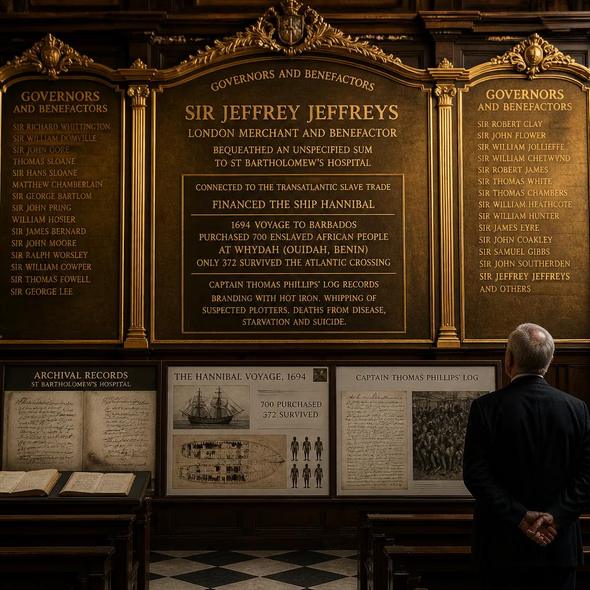
Historians compiling the Register of British Slave Traders have linked 24 Bank of England directors to investments in the trafficking of enslaved African people. Research by Dr Michael Bennett of the University of Sheffield found that four were founding directors when the Bank was established in 1694 and another 20 served at Threadneedle Street during the following century. Nine of the 24 also served as governors.
Bennett separately found that at least 30 founding subscribers invested in transatlantic trafficking. William III and Mary II, the king and queen when the Bank was founded, held shares in the Royal African Company. The research concludes that wealth generated through the slave trade formed part of the Bank’s initial capital and that the institution later provided financial services to clients including the Royal African Company and the South Sea Company.
Christopher Puller makes the overlap difficult to dismiss as a remote association. According to the register, he shipped weapons for the slave trade and co-owned a 1786 voyage that trafficked enslaved people from the Gambia to Jamaica. He served as a Bank director for 11 years before his death in 1789. The respectable title and the violent investment belonged to the same biography.
What the ledger was built to forget
The Bank’s familiar institutional story favors continuity: its founding in 1694, its governors, its role in public credit and its nationalisation under Clement Attlee’s Labour government in 1946. That chronology can make later public ownership feel like a cleansing boundary. It changed who owned the Bank. It did not change where earlier capital came from, whom the institution served or how the resulting fortunes continued to circulate.
This is why the new register is more than a list of compromised individuals. A list can quarantine blame inside several names while leaving the institution polished around them. The research instead describes a network of directors, subscribers, private banks, insurers and trading companies that converted captivity into shares, credit and standing. The old ledger was never merely decorative. It was a machine for turning human suffering into respectable entries.
The Bank now has practical choices. It can open the relevant subscription books, correspondence, client files and directors’ records to researchers; revise biographies and displays so investments are named alongside offices held; and explain what evidence remains missing or disputed. It can also trace the later movement of these fortunes through British finance rather than stopping at the moment a trader left the boardroom.
No display can reconstruct the lives reduced to cargo or recover every name omitted from the account. Disclosure can still change the public record. The next test is whether the Bank treats the register as an external correction to acknowledge or as a map for opening its own archives, revising its commemorations and following the money beyond the founders it has long remembered.
Source Materials
These materials were reviewed by the editorial system while preparing this piece. Muerte.casa may interpret, satirize, reframe, or disagree with them.
- Slave-trade wealth was embedded in Britain’s financial system, research finds The Guardian · September 15, 2026 · Primary signal · Direct source
How did this story land?
This may be changed as you like.