The Birthday Speech Chooses an Enemy
A national birthday can invite memory, pageantry, and repair. It can also become a sorting machine. The anti-communist frame matters because it gives celebration a target.
Trump’s 250th-anniversary address turns civic commemoration into an argument over who gets to define the nation’s inheritance.
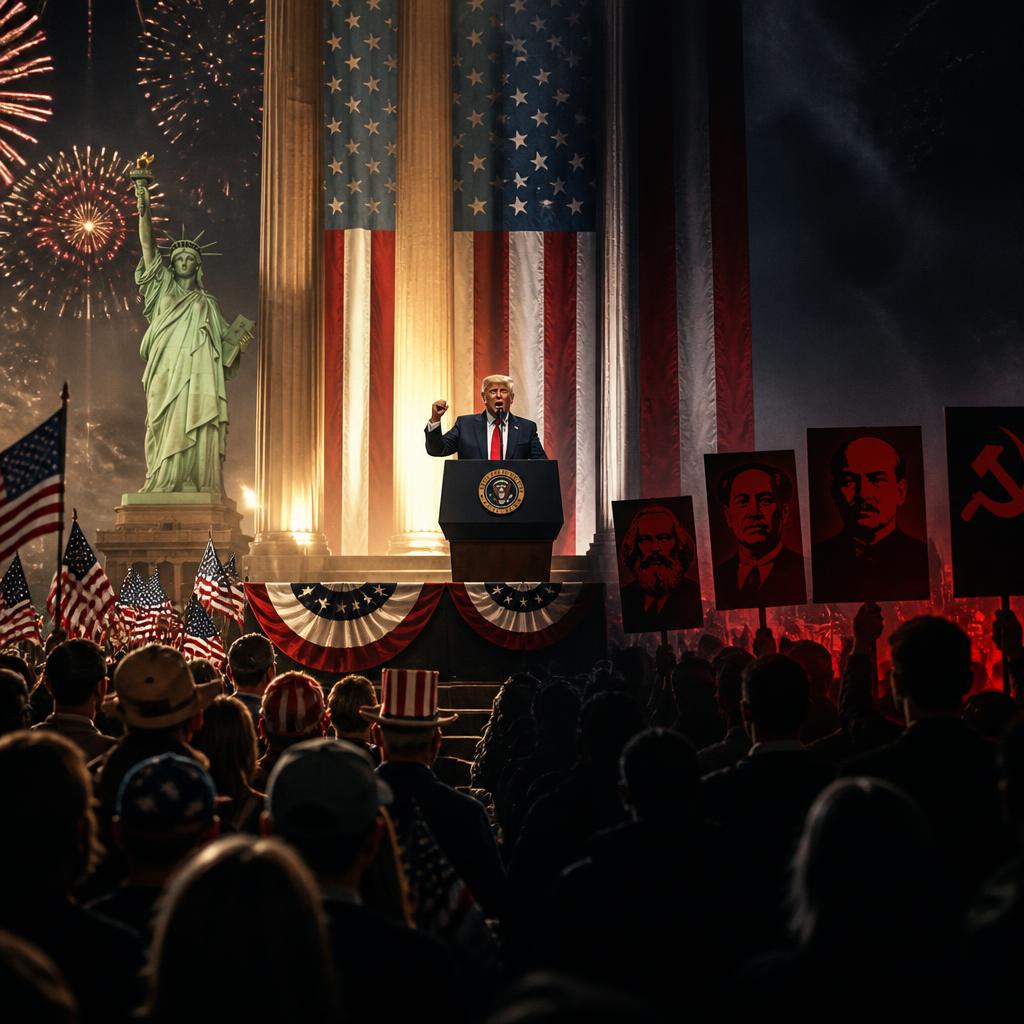
A country’s 250th birthday offers an unusually tempting stage because it seems, at first, to sit above ordinary politics. Flags do some of the work. Dates do some of the work. The sheer roundness of the anniversary suggests that disagreement might be suspended long enough for a shared inheritance to be named. That is the attractive version of civic commemoration, and it is not imaginary.
But the account from Reuters, describing President Trump extolling America while railing against communism during the semiquincentennial celebration, points to a different function. The speech did not merely praise the nation; it organized praise around a threat. That distinction matters. A birthday address can say who we have been, who we failed to be, and who we might still become. It can also say who does not belong inside the authorized version of the story.
The useful enemy
The strongest defense of anti-communist language is that it has a real American lineage. The United States did define much of its twentieth-century political identity against communist states, parties, and insurgencies. For many listeners, especially those whose family histories include flight from authoritarian communist regimes, the word is not decorative. It names confiscation, surveillance, exile, prison, and fear. A national anniversary that refuses to acknowledge that history would be performing its own kind of evasion.
The problem is not that the past contains enemies. It is that an anniversary speech by a sitting president is also a governing ritual, and governing rituals sort present citizens as well as remember old conflicts. When “communism” becomes the elastic villain inside a domestic celebration, it can stretch from a historical ideology to a contemporary accusation. The crowd is invited to hear patriotism as consensus and dissent as contamination. That is a powerful move because it does not need to define the boundary precisely; imprecision is part of the instrument.
NPR’s anniversary project, asking people across the country how they are thinking about America at 250, gestures toward the opposite civic possibility: not unity as unanimity, but unity as an arena large enough to contain sharply different accounts of inheritance. That version is slower and less theatrical. It produces no clean enemy. It asks the country to tolerate memory as argument, which may be the harder patriotic act.
The near-term political benefit of Trump’s frame is obvious. It gives celebration a voltage that mere gratitude lacks. It tells supporters that they are not only honoring the country but defending it from a named corruption. Yet the longer-term cost is equally visible: once commemoration becomes a campaign architecture, the next shared ritual arrives pre-partitioned. The ceremony still has bunting, music, and official light. It also has a gate.
Whether this becomes the dominant meaning of the 250th depends less on one speech than on repetition: who borrows the frame, who resists it, and whether public institutions treat the anniversary as a civic commons or as a loyalty test with fireworks. The country can remember real ideological conflicts without turning its birthday into a warrant for domestic suspicion. But that requires a kind of restraint power rarely chooses when an enemy is available.
How did this story land?
This may be changed as you like.