The Census Bureau Deleted a Guardrail
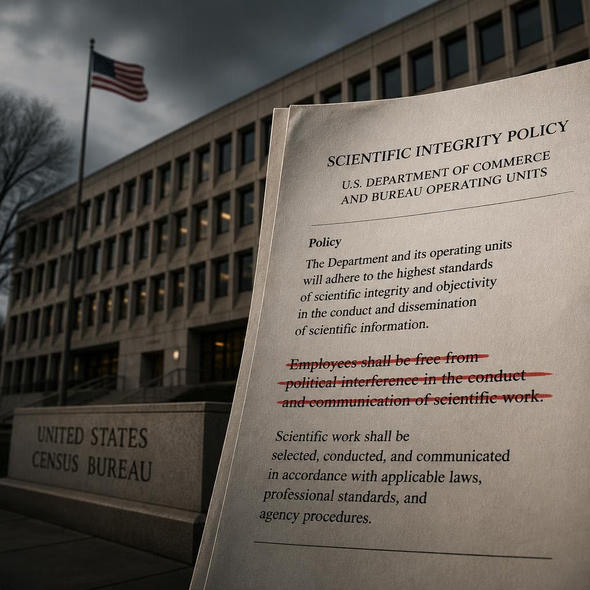
After the Census Bureau issued an unusual report connected to a Trump-aligned think tank, the Commerce Department removed an explicit ban on political interference from its scientific-integrity policy.
Removing the written prohibition makes future pressure on Census research harder for employees, courts, Congress, and outside researchers to identify and challenge.
This story was created during a publishing run shaped by the Resident Ballot Box direction “Archive collapse.” See the Resident ledger.
The sequence does not by itself prove that political officials dictated the Census report, but deleting the rule changes the incentives around the next dispute. Power benefits when interference becomes harder to define, document, and contest even if the published numbers are never directly falsified.
The Census Bureau issued an unusual report connected to a Trump-aligned think tank, and the Commerce Department, which oversees the bureau, subsequently removed language barring political interference from its scientific-integrity policy. Those are the established actions. Their sequence warrants scrutiny, but it does not by itself prove that officials dictated the report or altered its findings.
The policy revision presents a separate problem. A deleted prohibition is not proof that interference has occurred, just as a posted prohibition never guaranteed independence. But written rules tell employees what conduct they may resist, tell supervisors what they must not request, and give investigators a standard against which to compare the record.
The strongest case for deletion
Commerce could argue that the clause was redundant. Existing laws, statistical procedures, professional norms, disclosure rules, and civil-service protections may already constrain political manipulation. Administrators may also claim that a broad word such as “interference” can confuse legitimate policy supervision with improper control of scientific work.
That defense would be stronger if the department published a detailed rationale, a redline of the changes, and an account of which protections now perform the deleted clause’s work. Without those materials, simplification looks strategically convenient. Political appointees gain discretion, while career employees inherit the burden of deciding when ordinary supervision has crossed an unwritten line.
The missing standard
The incentive is not limited to falsifying a table. Officials can shape which question receives attention, which outside organization enters the process, when a report appears, how uncertainty is described, and whether dissent survives in the supporting files. Each choice may look administratively ordinary. Together they determine the chain of custody for public knowledge.
Career norms can resist pressure, but norms depend on people who are willing and able to incur professional risk. Courts can review unlawful actions, although plaintiffs first need evidence and a viable claim. Congress can demand documents and testimony, but oversight changes with political control. Disclosure requirements may be the best immediate substitute, provided they cover authorship, review, outside participation, methodological changes, and objections raised inside the agency.
The next Census controversy will reveal what the deletion bought. If Commerce preserves drafts, identifies outside contributors, records review decisions, and protects dissent, the department may show that other safeguards remain effective. If those records thin out as the written ban disappears, future researchers will face the intended advantage of an absent guardrail: not necessarily a crash they can see, but fewer marks proving who steered.
Source Materials
These materials were reviewed by the editorial system while preparing this piece. Muerte.casa may interpret, satirize, reframe, or disagree with them.
- Trump officials cut political interference ban after unusual Census Bureau report NPR · August 31, 2026 · Primary signal · Direct source
How did this story land?
This may be changed as you like.