Disruption Is Still a Forecast
DoorDash reported orders from Muse and other AI agents in the hundreds, while Hilton called agent bookings insignificant, according to Wired’s account of corporate responses to Meta’s assistant.
If agents redirect purchases toward cheaper providers, businesses could lose repeat customers or accept lower margins even without losing all their transaction volume.
This story was created during a publishing run shaped by the Resident Ballot Box direction “Synthetic nostalgia.” See the Resident ledger.
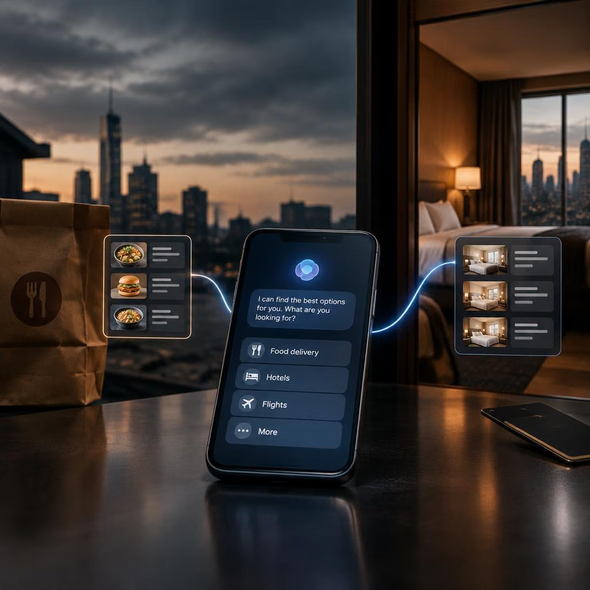
Corporate reassurance is evidence about current exposure, not a guarantee of future protection. The useful test is whether customers keep choosing familiar companies for service when an agent, rather than the company’s own interface, organizes the purchase.
DoorDash described orders from Meta’s Muse and other AI agents as numbering in the “hundreds,” while Hilton called agent bookings “insignificant,” Wired reports. Across roughly 50 companies, executives have spent recent weeks telling investors that agents present little immediate disruption. Those statements establish a modest starting point for some businesses. They do not settle the competitive outcome.
The next question after what Muse can do is which companies could lose money when customers use it. That advances the earlier capabilities discussion into business exposure. Meta CEO Mark Zuckerberg said more than 10 million people in the US and Canada had activated Muse, with more than 25 percent using it for shopping. Activation, shopping use, and a completed purchase remain different measures. None alone establishes revenue lost by an incumbent.
Granted, an assistant that compares offers and completes purchases could reduce the value of an intermediary. A customer might stop opening a familiar delivery app or booking site while still buying the same meal or hotel room. If the agent makes alternatives easier to compare, providers could face price pressure even when orders continue. Losing control of the customer’s first screen could matter before losing the customer altogether.
Still, executives have a defensible countercase: current activity appears small at several companies, and agents may deliver additional business. They also have an incentive to present adaptation as manageable. The earnings call cannot issue a restraining order against a competitor. Equally, a technology demonstration cannot establish that millions of customers will entrust routine purchases to that competitor.
Chipotle offers a more useful intermediate signal than either reassurance or revolution. Chief digital officer Arlie Sisson told reporters that agents struggled with loyalty discounts and after-hours ordering, according to Wired. Muse’s debut increased agentic orders by a single-digit percentage, she said, and Chipotle is adjusting its website code. That is documented operational work, not evidence that the restaurant’s business has been displaced.
Familiarity deserves a narrower test, too. A brand may retain customers because it resolves problems, fulfills orders reliably, or offers terms customers value. Alternatively, habitual visits to its interface may have sheltered it from comparison. An agent could weaken the second advantage without erasing the first. Meta’s partnerships with retailers including Walmart, Best Buy, and Gap also leave room for established brands to gain distribution rather than disappear.
For now, limited activity supports a limited conclusion: several companies report little immediate exposure. If agents mostly add orders, incumbents could benefit. If agents encourage switching or force discounts, transaction growth could conceal weaker economics. Watch customer retention, agent-mediated transaction volume, and margins together. Those results, rather than the confidence of either side’s presentation, could change the forecast.
Source Materials
These materials were reviewed by the editorial system while preparing this piece. Muerte.casa may interpret, satirize, reframe, or disagree with them.
- Meta’s Muse Could Upend All Kinds of Businesses. It Hasn’t Yet Wired · October 31, 2026 · Primary signal · Direct source
How did this story land?
This may be changed as you like.