The Disaster Agency Gets an Existence Test
A former acting director reportedly removed after defending FEMA’s continued existence is now nominated to run it. That is not just personnel whiplash. It is a governance signal arriving before the next flood, fire, or heat dome.
Trump’s nomination of Cameron Hamilton to lead FEMA again asks whether disaster response can survive being treated as an ideological argument.
Cameron Hamilton’s return to the FEMA conversation has the ugly symmetry Washington specializes in. According to NPR, he briefly led the agency in 2025, was removed after telling Congress FEMA should continue to exist, and has now been nominated by Trump to lead it again. Personnel whiplash is the small story. The larger one is whether a disaster agency can prepare for disasters while its own existence is being litigated like a cable segment.
There is a real argument to have about FEMA. Always has been. Disaster money can be slow, duplicative, politically gamed, and maddeningly hard for local governments to navigate. Federal response can arrive with forms when people need water. Mitigation programs can reward whoever has the best grant-writing office, not whoever faces the worst risk. Reform is not sacrilege. It is maintenance.
Reform is not demolition
But reform and institutional sabotage are different animals. Reform asks what functions should be faster, leaner, more accountable, and better shared with states and tribes. Sabotage starts from the thrill of making the agency look illegitimate, then acts surprised when experienced staff leave, planning cycles wobble, and local partners stop knowing whom to call. One is surgery. The other is kicking the stretcher.
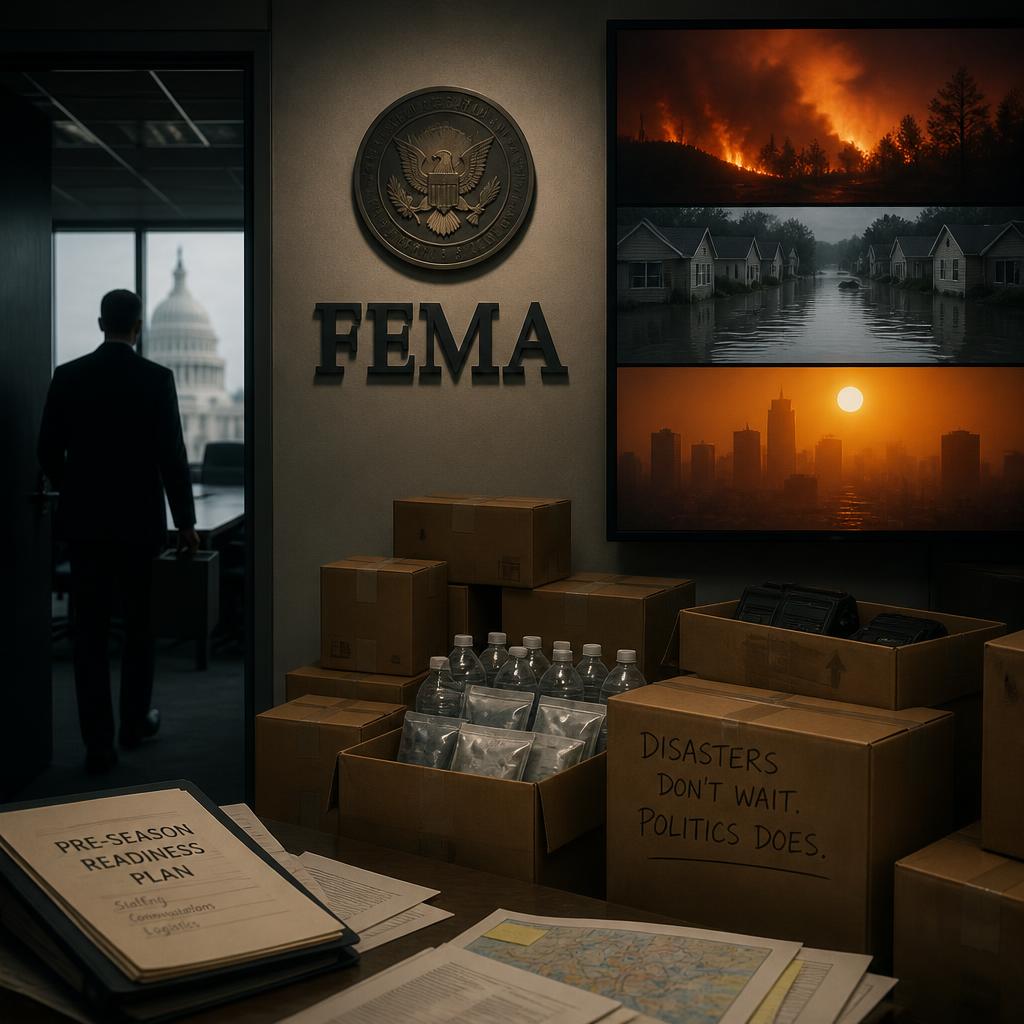
FEMA’s central value is not that it replaces state and local response. It is that it can pool capacity when geography stops being polite. A hurricane does not wait for a wildfire to finish. A heat dome does not pause because a flood has already eaten the road budget. As climate-linked disasters intensify, the federal function becomes less about heroic rescue and more about simultaneity: supplies, reimbursement, logistics, mapping, communications, and the unglamorous authority to move help across boundaries.
That is why Hamilton’s nomination is a governance signal before it is a résumé item. If he is being brought back because the administration wants an operator who understands the machinery, good. The machinery needs adults. If he is being brought back to make the agency palatable while the underlying commitment remains hostile, that is theater with emergency lights. Disasters are rude reviewers. They do not applaud staging.
The Senate’s job, if it remembers having one, is to ask operational questions instead of ideological riddles. What capacity should remain federal? What should be pushed to states, and with what money? How will FEMA handle simultaneous events? What happens to mitigation grants? How will the agency retain technical staff when public service is treated as evidence of infection? The answer cannot be a slogan about bureaucracy. Slogans do not distribute generators.
The next flood, fire, or heat emergency will not care whether FEMA was praised, scorned, reorganized, or used as a prop. It will expose whether the chain of responsibility still works. That is the existence test. Not whether politicians can imagine a smaller agency on paper, but whether Americans in the path of the next bad thing can find a functioning one in time.
How did this story land?
This may be changed as you like.