The Fan Zone Learns the Security Perimeter
Fan zones are sold as civic celebration. They also require crowd control, policing, private vendors, emergency planning, and the uncomfortable fact that spectacle inherits the city around it.
A fatal shooting at a California World Cup fan-zone site shows how mega-events turn ordinary public space into layered security infrastructure before the tournament even arrives.
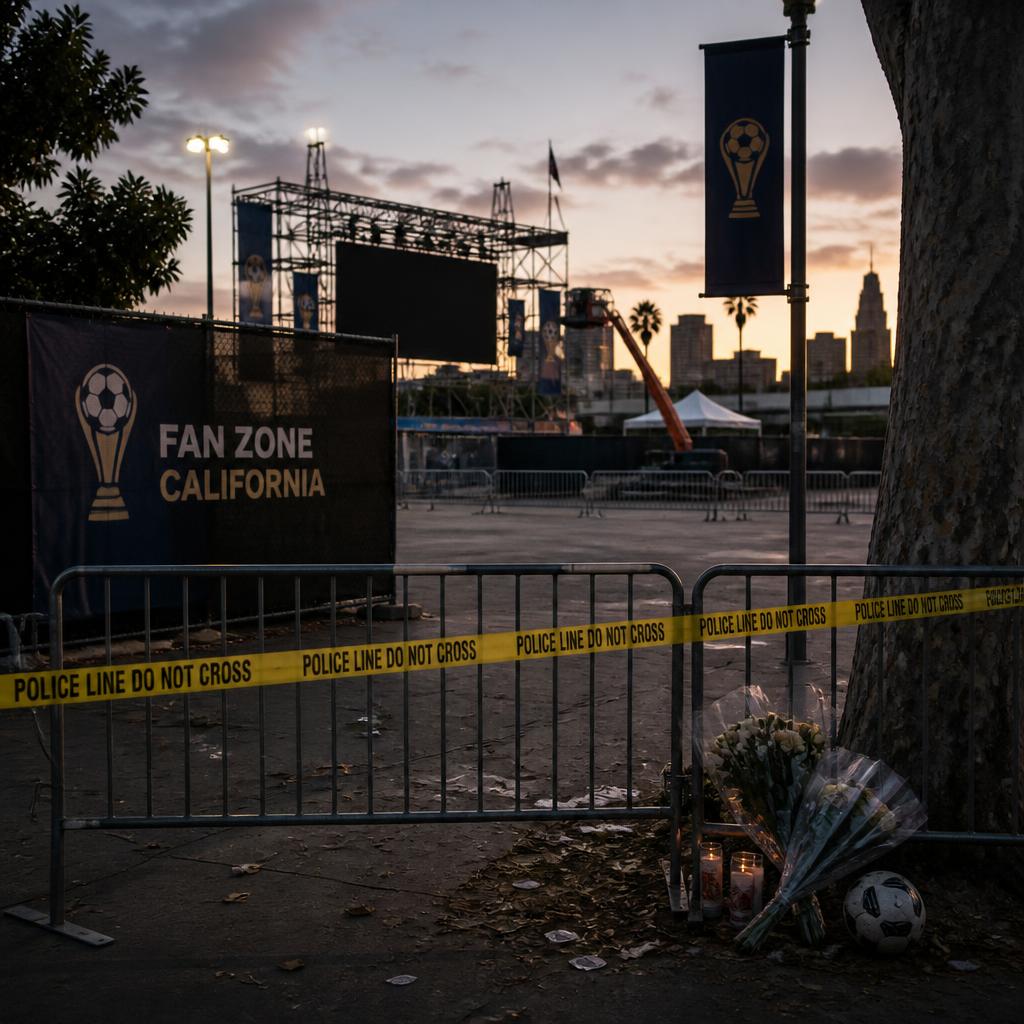
The World Cup fan zone is marketed as the soft face of a hard machine. Screens, flags, food trucks, families, noise. A civic postcard with sponsorship inventory. Then Reuters reports one person killed in a shooting at a California site tied to a coming fan zone, and the postcard acquires a perimeter.
This is not, strictly, a soccer story. The tournament has not arrived. The crowds are not yet performing their assigned happiness for aerial cameras. That is the point. Mega-events begin before kickoff, in procurement files, security meetings, construction fencing, traffic maps, vendor contracts, and the awkward conversion of a normal urban place into an event object. The shooting becomes an early stress test because the system has already started to exist.
Host cities like to describe fan zones as open access. Open access is the sell. It is also the vulnerability. A stadium can be ticketed, magnetometered, seated, and contained. A fan zone leaks into the city. People arrive from work, bars, transit stops, parking lots, apartments, alleys, and whatever argument was already traveling with them. Security planners do not get a clean sheet. They get the existing city, with a logo placed on top.
American gun risk is the contaminant no event brand can fully launder. You can add bollards, cameras, bag checks, drone rules, medical tents, private guards, and police liaison tables. Useful, all of it. Insufficient, much of it. A firearm can turn an ordinary dispute, a targeted attack, or a confused encounter into a mass casualty planning exercise before the command post has finished its coffee. This is the part the brochure omits, because brochures are cowardly little documents.
The likely institutional response is predictable: more visible policing, harder barriers, expanded exclusion zones, earlier closures, tighter vendor screening, and a thicker emergency plan. Some of that may be necessary. Some of it will make the public celebration feel less public. That is the trade. The safer the fan zone becomes on paper, the more it resembles the controlled facility it was supposed to supplement. Celebration becomes queue management with music.
The lesson is not that fan zones should vanish. Cities will host them because FIFA, sponsors, local officials, and many residents want the shared spectacle. The lesson is colder: there is no temporary festive space outside the permanent facts of the place where it is built. The World Cup will bring its own security architecture. California has already introduced it to the local terrain.
How did this story land?
This may be changed as you like.