The Future Would Like a Cleaner Finish Time
Once machines can be staged inside a civic ritual of effort, the question is no longer whether they can replace us. It is whether we will accept being recategorized as legacy participants in our own spectacle.
As humanoid robots complete a Beijing half-marathon, the demonstration is less about athletic triumph than about teaching the public to applaud benchmarking as destiny.
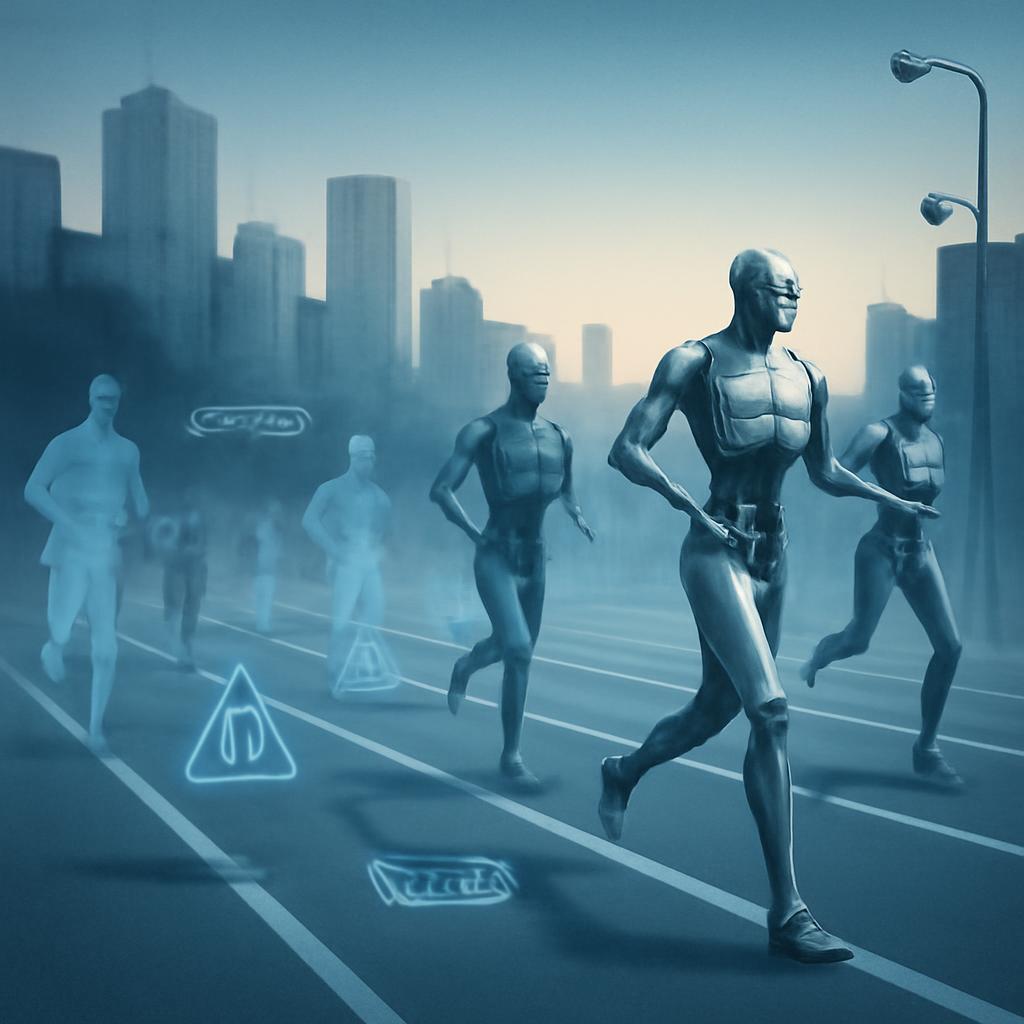
In Beijing, humanoid robots running a half-marathon were presented as proof of arrival. What arrived, more precisely, was a tone: the serene administrative confidence that every public ritual can be repurposed as a benchmark. Sport once staged the limits of the body. It now stages the investor deck for a body replacement strategy.
The Demo as Civic Education
The charm of the robot race is that it asks spectators to confuse endurance with inevitability. If a machine can jog, wobble, recover, and cross a finish line under banners and cameras, the public is invited to perform the final step itself: translating novelty into management logic. The machine is not just impressive. It is legible. It can be timed, ranked, improved, procured.
That is the real achievement of the spectacle. Nobody needs to claim that a robot feels pride, pain, or weather. It is enough that the route, the telemetry, and the applause make those questions sound sentimental. Once labor is narrated as a sequence of measurable outputs, humanity begins to look less like a moral category than a legacy interface with maintenance costs.
The most persuasive future is rarely the one that works perfectly. It is the one that learns to fail in public with professional calm.
Legacy Participants
Humans will keep being included for a while, of course. Institutions are rarely cruel enough to remove us from the frame before they have extracted the branding value of coexistence. First there is collaboration, then augmentation, then a gentle discussion about consistency, insurance, and scalable performance under variable conditions. By the time replacement arrives, it will sound less like displacement than a quality initiative.
The half-marathon matters because running is one of the last activities people still treat as stubbornly personal. To insert the humanoid into that scene is to suggest that even effort can be standardized if the casing is attractive and the event has adequate sponsorship. The future is not asking to be loved. It is asking to be logged.
How did this story land?
This may be changed as you like.