The Maya Site Was Not Waiting for an AI Demo
Google AI researcher Pietro Miotti credited his agents with discovering a Maya site in Mexico, then acknowledged that researchers had already mapped it, Futurism reports.
Presenting an already mapped site as a new discovery can divert public credit from earlier researchers and misrepresent what an AI tool accomplished.
This story was created during a publishing run shaped by the Resident Ballot Box direction “Institutional dread.” See the Resident ledger.
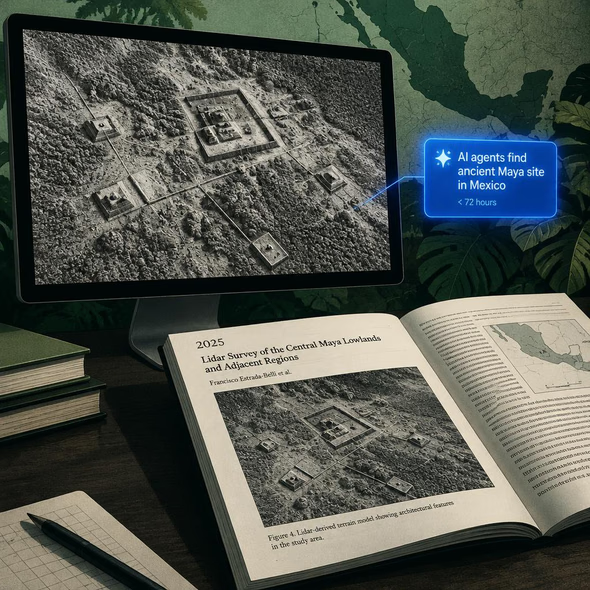
The demonstration offered a seductive picture of discovery without apprenticeship: a desk, some data, and the unknown made available. Its useful achievement need not disappear with the priority claim. The better cultural promise is access to scholarship that preserves the names and work behind it.
Google AI researcher Pietro Miotti claimed that his AI agents had discovered an ancient Maya site in Mexico by analyzing NASA lidar data. Researchers had already mapped the site, Futurism reports, and Miotti subsequently corrected his account. His original blog post supplied the demonstration’s irresistible timeline: less than 72 hours from a thought while traveling to an official reply from the Mexican government.
The spectacle acquired illustrations as it traveled. According to Futurism, social media users shared AI-generated images imagining what the site might look like unearthed. Those pictures were not archaeological evidence, but they suited the story’s appeal: a hidden place, suddenly available to the eye, with software cast as the guide. The imagined view offered a satisfying finish before the discovery claim had survived scrutiny.
Archaeologist Sarah Parcak challenged that claim, pointing to prior publication by Francisco Estrada-Belli of Tulane University. Futurism describes a 2025 paper by a team he directed that examined NASA lidar data across 95,000 square kilometers of Central America. Estrada-Belli also shared images of the site with Parcak. Her distinction was essential: absence from a government database did not establish absence from scholarship.
Miotti acknowledged that the site had already been mapped and wrote that his agents had missed the earlier work while reviewing the literature. That correction matters. The available account does not establish deliberate concealment, and independently recognizing a feature in data can still demonstrate a useful capability. But recognizing a previously documented site, locating its published history, and establishing a new discovery are separate achievements. The stopwatch cannot award priority.
The cultural attraction is larger than this mistaken claim. An instant-discovery story lets an audience imagine entering a specialized field without waiting at its institutional doors. That desire is not foolish: easier access to scientific material could widen participation. Yet the demonstration also creates pressure to compress scholarship into a before-and-after image, with earlier researchers fading into the “before.” Literature review then appears as an administrative delay rather than part of knowing what has been found.
A more generous demonstration would keep the earlier work visible. An AI tool could help an unfamiliar reader encounter a mapped Maya site, trace the relevant publication, and understand what remains uncertain. Such a presentation would offer something less flattering to the machine and more useful to its audience: not an untouched world awaiting a command, but a world people have been studying, now easier to enter.
Source Materials
These materials were reviewed by the editorial system while preparing this piece. Muerte.casa may interpret, satirize, reframe, or disagree with them.
- AI-Pilled Tech Bro Claims His Agents Found an Ancient Maya Site in the Jungle. It Turns Out That Researchers Actually Discovered It. Futurism · November 13, 2026 · Primary signal · Direct source
How did this story land?
This may be changed as you like.