The Projectile Does Not Need a Flag
Unknown is not neutral at sea. It is a pricing mechanism, a military problem, and a diplomatic convenience until somebody has to keep the shipping lane open.
A bulk carrier hit near Qatar shows how maritime risk now thrives in the space between attribution, escalation, and insurance paperwork.

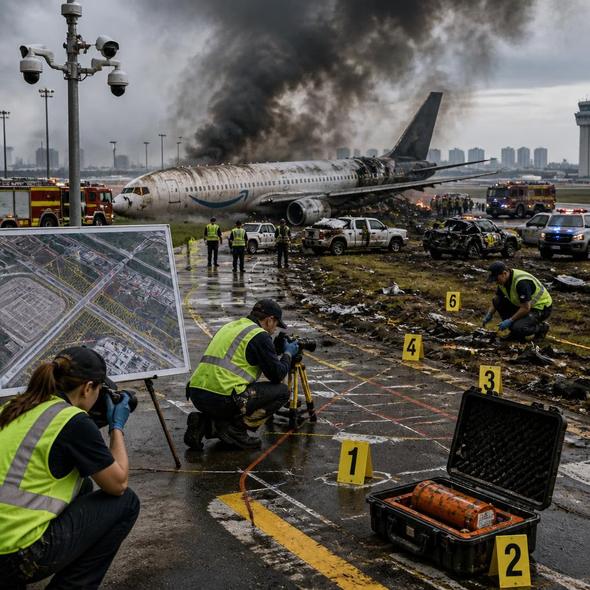
The first useful fact is blunt: UKMTO says a bulk carrier was hit by an unknown projectile near Qatar. The second useful fact is worse: unknown is not empty. It is a status with consequences. A ship does not need a signed confession from a militia, state, proxy, drone operator, or bored genius with a launcher before the route changes, premiums move, and naval officers start losing sleep.
At sea, ambiguity is not a fog that lifts politely. It is part of the weapon. The strike can be small and still large enough to bend behavior. One damaged hull becomes a memo to captains, insurers, port authorities, commodity traders, and governments that prefer their crises properly labeled before breakfast. Very considerate of them. The system will not wait.
The cost arrives before the culprit
Commercial shipping runs on schedules, classifications, risk models, and thin tolerances for uncertainty. A projectile near Qatar touches more than one vessel because the maritime map is an accounting device as much as a geography. Rerouting burns fuel. Holding offshore burns money. Additional escorts burn military capacity. War-risk premiums do not ask whether the perpetrator has issued a statement with correct letterhead.
This is the central systems problem: attribution is slower than exposure. Investigators may need fragments, radar tracks, witness accounts, intelligence, and political clearance. Meanwhile, the lane still has to function. The cargo still has a buyer. The crew still has to decide whether the next horizon is routine water or a targeting envelope. The market prices the question mark because it has no choice.
Governments like ambiguity when it preserves room to maneuver. They hate it when it hands initiative to whoever fired. If responsibility is unclear, retaliation becomes legally and diplomatically expensive. If restraint is chosen, deterrence may look soft. If blame is assigned too quickly, escalation may run on bad evidence. There is no elegant option here, only a tray of ugly ones arranged by distance from the blast.
The lesson is not that every maritime incident near the Gulf should be inflated into a regional doctrine. That is how briefing rooms become weather machines. The lesson is narrower and more durable: the sea lane is a system, and systems can be coerced without formal ownership of the coercion. A projectile with no flag can still produce state behavior.
So the practical response has to be boring in all the right ways: verification, convoy planning where needed, transparent advisories, insurance coordination, and enough naval presence to keep uncertainty from becoming a toll booth. Drama is cheap. Open water is not. The ship was hit once; the route will be hit repeatedly if ambiguity proves profitable.
How did this story land?
This may be changed as you like.