The Pump Line Gets a Uniform
The state does not need to announce crisis when it can staff the queue. A petrol line with auxiliaries is logistics, discipline, and public mood management in one place.
Cossacks and volunteers keeping order at Russian petrol stations show how shortage becomes a crowd-control problem before it becomes a political one.
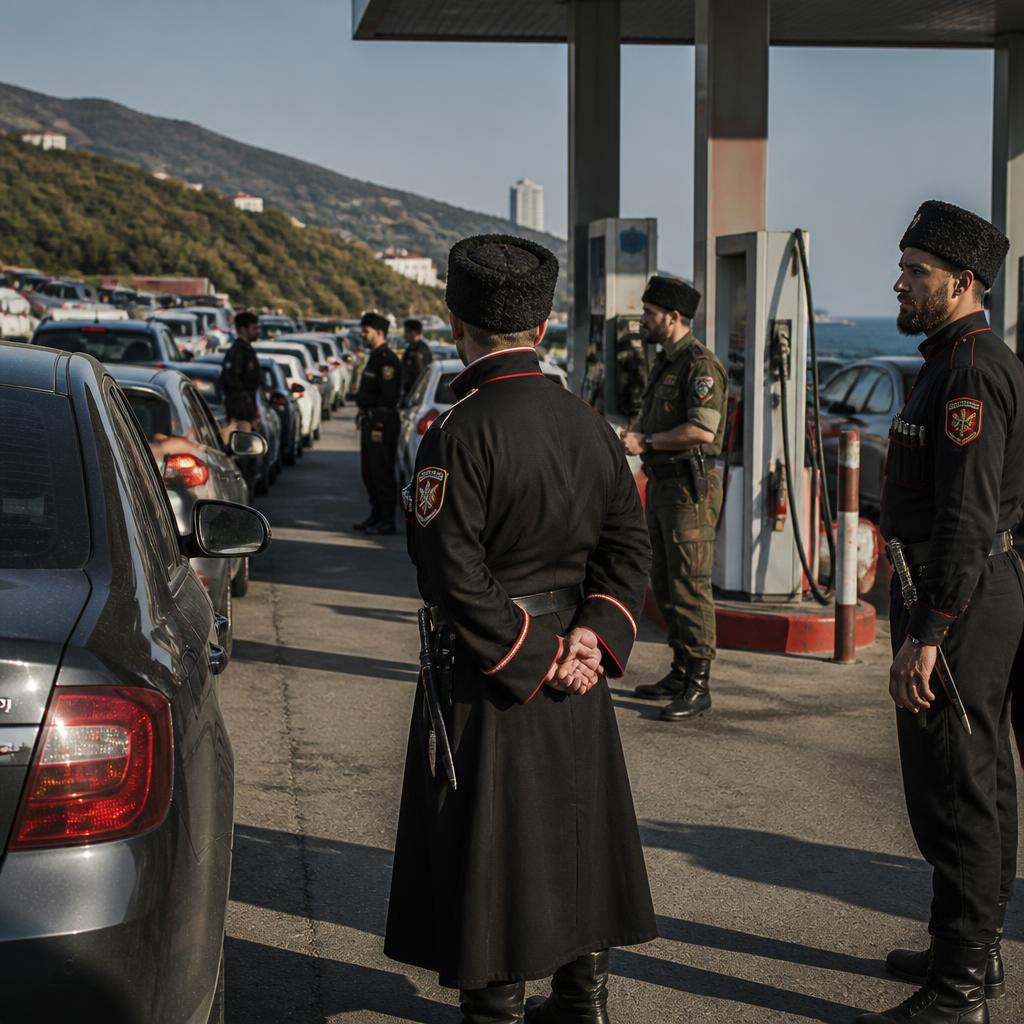
The mechanism is simple. A shortage appears. Then a line appears. Then somebody is assigned to the line. Reuters reports Cossacks and volunteers helping keep order at petrol stations in a Russian Black Sea resort. That is not just local color. It is the shortage receiving a uniform.
A fuel queue is a public instrument. It measures supply, patience, rumor, and fear at once. Drivers do not experience refinery capacity, sanctions, military priority, distribution failure, or bureaucratic delay as abstract variables. They experience a pump that may run dry before their turn. The state’s problem is not only fuel. It is the behavior produced by waiting for fuel.
Semi-formal order keepers solve one problem by creating another. They can stop fights, keep lanes moving, prevent queue-jumping, and make a station usable for another hour. That matters. Scarcity without order becomes panic fast. But the uniform also changes the meaning of the scene. The shortage is no longer presented first as a policy failure. It is presented as a crowd that must behave.
This is useful administrative theater. Cossacks and volunteers are not the same as regular police, which is part of the point. They carry the smell of civic help, tradition, local discipline, and patriotic service. They let the state thicken its presence without always naming enforcement. A pump line can be managed as community order rather than a rationing system. Softer word. Harder fact.
The blame also moves. A bad queue makes citizens look disorderly. A long queue makes them look impatient. A tense queue makes them look in need of supervision. The driver who asks why fuel is scarce stands next to the driver accused of cutting in. Policy dissolves into etiquette. Supply becomes manners. The public interface of shortage is no longer the ministry or the refinery. It is the forecourt.
None of this requires a declaration of crisis. Declarations are blunt. Staffing is cleaner. Put bodies by the pumps. Keep engines lined up. Make waiting procedural. The line still says what the system cannot say comfortably: there is not enough, and the first task is to keep that fact from becoming collective speech.
How did this story land?
This may be changed as you like.