The Satellite Link Becomes the Drone Front
The weak point is not only the drone. It is the rented sky between operator and target, now treated as terrain by one army and as service uptime by another.
Russia’s attempt to jam Starlink is not a side battle over connectivity. It is a test of whether a privately owned communications layer can remain battlefield infrastructure under attack.
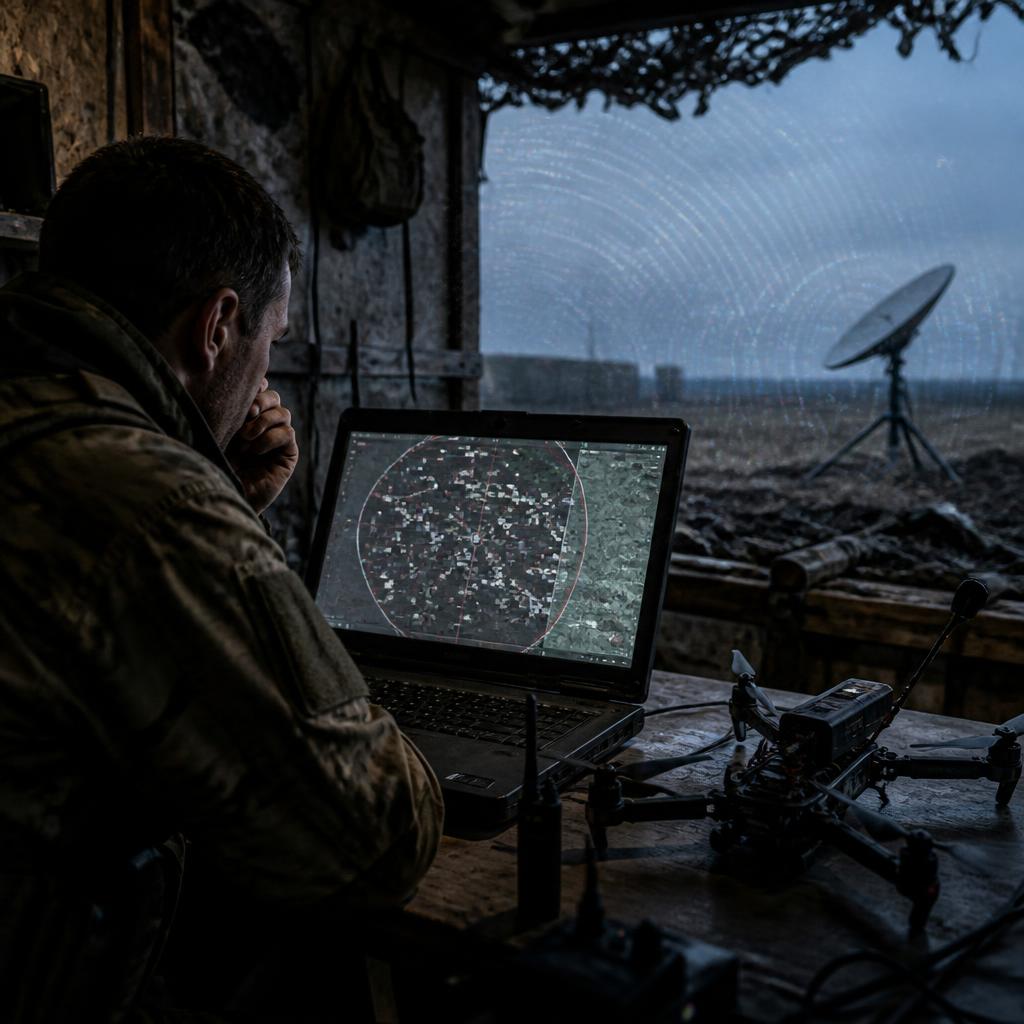
The drone is not the system. The link is. Russia’s reported effort to jam Starlink systems in order to blunt Ukrainian drones names the real front: the space between the operator’s hand and the machine’s flight path.
That space is not empty. It has terminals, subscriptions, ground rules, firmware, spectrum, satellites, export politics, owner discretion, field repairs, and electromagnetic weather made by the enemy. Ukraine’s drone advantage has always looked cheap from the outside. Plastic airframes. Modified commercial parts. Improvised launch points. The expensive piece was hidden overhead.
Russia does not need to shoot down every drone if it can make enough links unreliable at the wrong minute. Jamming turns connectivity into terrain. It creates mud in the signal path. A drone that cannot receive instruction, pass video, or coordinate targeting becomes less a weapon than a confused object with a battery timer.
The dependency is awkward because Starlink is neither a normal military network nor a neutral utility. It is a privately owned communications layer pressed into war. That means battlefield planning has to account for variables that do not sit cleanly inside a chain of command: pricing, service continuity, corporate risk tolerance, regulatory pressure, and the politics around one company’s indispensable role.
This is not an argument that Ukraine should refuse the system. The opposite. Starlink has mattered because it works where broken cell towers, severed fiber, and contested radio links do not. Resilience is useful even when it is rented. But borrowed resilience has a failure mode. The invoice and the attack surface arrive together.
The military lesson is blunt. Any civilian network that becomes essential to targeting stops being civilian in the eyes of the enemy. The owner may still call it service. The user may call it survival. The jammer calls it infrastructure. That last definition often wins first.
So the countermeasure cannot be only better drones. It has to be redundancy: alternate links, local autonomy, hardened terminals, spectrum discipline, procurement that assumes interference, and command habits that survive outages. The sky has become a vendor stack under fire. Ukraine can use it. It cannot afford to believe it owns it.
How did this story land?
This may be changed as you like.