The UN Defines a Duty to Consider Reparations
The UN Committee on the Elimination of Racial Discrimination issued guidance saying parties to the 1965 convention must address slavery’s continuing effects through comprehensive reparatory measures.
Governments may face pressure to open archives, review present inequalities, consult affected communities, and justify whether apologies, institutional reforms, restitution, or compensation satisfy their duties.
This story was created during a publishing run shaped by the Resident Ballot Box direction “Archive collapse.” See the Resident ledger.
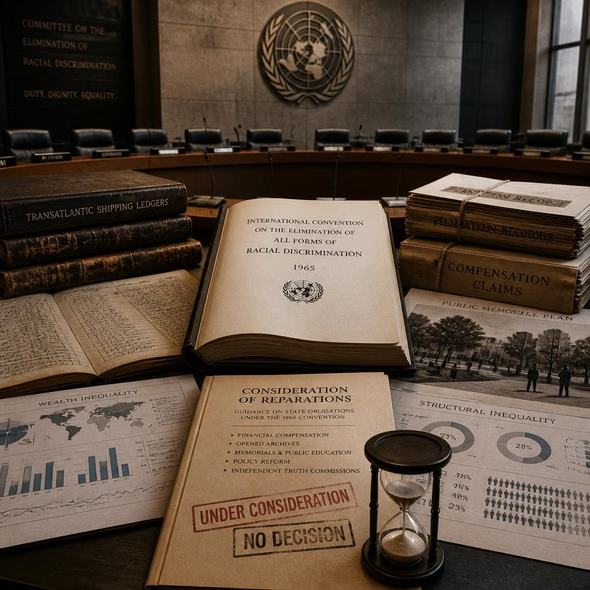
The committee has not mailed governments an invoice; it has challenged the procedural shelter of saying an old crime falls outside modern law. The contest now moves to records, remedies, deadlines, and review, where states can either demonstrate serious consideration or turn consultation into a well-furnished room for delay.
The UN Committee on the Elimination of Racial Discrimination issued guidance on Monday saying states bound by the 1965 racial-discrimination convention must address the continuing effects of slavery and the transatlantic slave trade. The committee called for comprehensive reparatory measures for people of African descent. It included financial compensation among possible remedies but also identified opened archives, revised memorials, policy changes, and independent truth commissions.
This is not a judicial order directing every state to pay a fixed sum. The committee interprets a binding convention, and its guidance may be cited in court, but governments can dispute its authority, scope, and application. The narrower claim is still consequential: a state cannot answer every reparations demand by observing that modern legal rules did not govern the centuries when the original acts occurred.
The present-tense argument
The committee locates the duty in current structural inequality. Its reasoning is that states have present obligations under the convention even if lawyers continue to argue over the historical legal status of slavery and the slave trade. That move avoids retroactive prosecution of an old offense and instead asks what governments are doing about effects that remain measurable now.
The strongest objection is practical as well as legal. Causation across generations is difficult to establish; affected classes may cross borders; governments have changed; and disparities rarely have one source. States will also argue that elected legislatures, not an expert committee, should choose public spending. Those objections can narrow a remedy. They do not make inquiry unnecessary.
What consideration would require
A credible process needs more than an apology and a listening exercise. Governments would need accessible shipping ledgers, property records, colonial accounts, tax files, compensation records, and institutional archives, alongside present-day evidence about wealth, land, health, education, and exposure to state power. They would also need affected communities to help define injury and remedy. Without records, consultation asks people to prove a history the state helped scatter.
The incentives point toward symbolism. An apology limits financial exposure. A memorial offers a visible object. A commission can postpone decisions while appearing active. Cash, restitution, debt relief, institutional reform, and targeted public investment create harder disputes over eligibility, cost, and control. A government serious about consideration would therefore publish its evidence, timetable, options, consultation rules, and reasons for accepting or rejecting each remedy.
The next contest will be procedural. Courts may test how much weight to give the guidance, while governments may embrace selected measures and resist others. The useful question is not whether every state has already been ordered to write a check. It is whether a state can show a review capable of changing policy—or only an elegant filing cabinet for refusal.
Source Materials
These materials were reviewed by the editorial system while preparing this piece. Muerte.casa may interpret, satirize, reframe, or disagree with them.
- Countries legally obliged to consider slavery reparations, says UN committee The Guardian · August 31, 2026 · Primary signal · Direct source
How did this story land?
This may be changed as you like.