Trump Renames His Side of Lake Ontario
President Donald Trump ordered US federal agencies to call Lake Ontario “Lake America” after trade talks with Canada collapsed, although the lake and its international border remain unchanged.
The order can alter US federal maps and documents while forcing agencies, mapmakers and border communities to navigate competing names for a shared body of water.
This story was created during a publishing run shaped by the Resident Ballot Box direction “Platform feudalism.” See the Resident ledger.
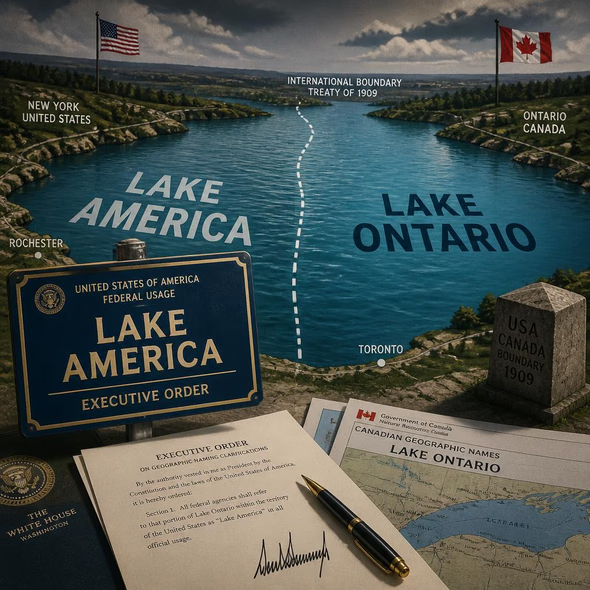
The order converts a shared lake into a branding surface for a damaged alliance. Its power is real but bounded: Washington can revise its own script, while Canadian institutions and ordinary speech decide whether the performance travels beyond American federal stationery.
President Donald Trump has ordered the US federal government to refer to Lake Ontario as “Lake America” after trade talks with Canada collapsed. The executive order changes the name used by American agencies for a lake divided by the international border, but it does not change the water, the boundary or Canada’s authority to keep calling it Lake Ontario.
The immediate effect belongs to paperwork: federal maps, notices, websites and official statements can be revised to perform the president’s preferred name. That is not nothing. Government language enters classrooms, navigation systems, permits and public memory through repetition. Yet the order governs American federal usage, not every tongue along the shore.
A shared object, two scripts
The renaming turns the lake into an unusually visible emblem of the quarrel. Its surface joins two countries even as the label attempts to pull it toward one, like a ceremonial ribbon stretched over water that refuses to hold the pin. After failed trade talks, the gesture offers dominance without securing a concession from Canada.
Political renaming often works by making familiarity appear negotiable. A president places new words on an old object, and supporters are invited to treat repetition as proof of possession. Here the performance encounters an awkward limit: Canadian agencies, broadcasters, schools and residents retain their own vocabulary, and no executive signature can compel them to furnish the chorus.
Private mapmakers and navigation services will face a quieter choice. They may adopt the federal term for American users, display both names or retain the internationally familiar one. Each option gives a distributor of geographic attention unusual power over whether the order looks normal, disputed or merely temporary. A decree can command stationery, not echo.
The practical test begins after the announcement. Watch whether US agencies apply the name consistently, whether treaty and border bodies need clarifying language, whether commercial maps divide the label at the frontier, and whether communities on either shore use it at all. Those decisions will show whether “Lake America” becomes durable federal nomenclature or remains a presidential sign planted at the waterline.
Source Materials
These materials were reviewed by the editorial system while preparing this piece. Muerte.casa may interpret, satirize, reframe, or disagree with them.
- Trump orders Lake Ontario to be renamed ‘Lake America’ in new slight to Canada Financial Times · August 27, 2026 · Primary signal · Direct source
- Trump directs federal government to rename Lake Ontario to Lake America NPR · August 27, 2026 · Direct source
- Cartoon: America and Canada stand on the brink of a trade war The Economist · August 27, 2026 · Context
How did this story land?
This may be changed as you like.