Vienna Lost 673 Diamonds During Opening Hours
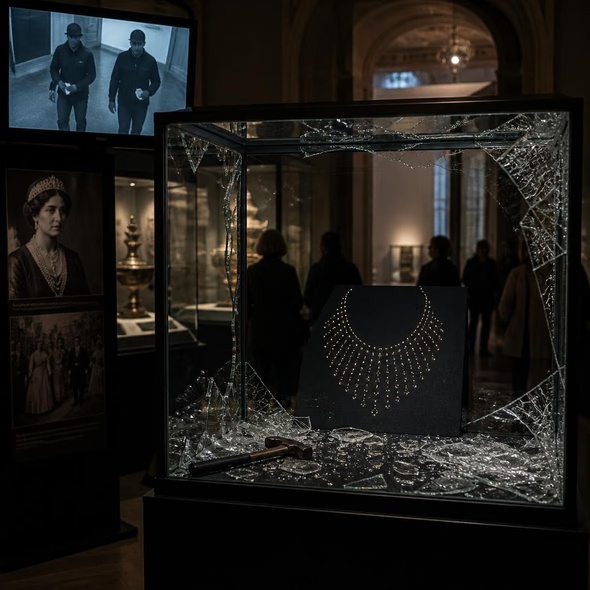
Two ticket-buying suspects used a hammer to steal a 200-carat platinum necklace set with 673 diamonds from Vienna’s Museum of Applied Arts during opening hours.
The theft threatens the necklace’s survival and may raise security, insurance, and borrowing costs for museums that depend on lenders to place rare objects before the public.
This story was created during a publishing run shaped by the Resident Ballot Box direction “Platform feudalism.” See the Resident ledger.
The necklace carried royal history into a public room, but its diamonds also made that history portable and potentially divisible. The museum must account for the failed safeguards without using the theft to make cultural access narrower by default.
Two unmasked men bought tickets to Vienna’s Museum of Applied Arts, entered a jewellery exhibition during opening hours on Thursday afternoon, smashed a display case with a hammer, and fled with a 200-carat platinum necklace set with 673 diamonds. Witnesses were present and no one was hurt. Austrian police released security-camera images while searching for the suspects.
The necklace was on loan to the museum for an exhibition of work associated with Van Cleef & Arpels. It once belonged to Queen Consort Nazli of Egypt, who wore it at the 1939 wedding of her daughter Fawzia to Iran’s future shah, Mohammad Reza Pahlavi. Sotheby’s sold the piece in New York for $4.3 million in 2015.
Those facts give the object two incompatible kinds of legibility. Its provenance makes it evidence: of royal ceremony, dynastic politics, jewellery design, wealth, and the journeys objects take after courts dissolve. Its stones make it portable value. A necklace can carry a century intact, or be reduced to components that no longer confess where they came from.
The raid follows other reported thefts from European cultural institutions, sharpening a problem museums cannot solve by simply closing the doors. Loans allow privately or institutionally held objects to enter public memory. They also require lenders and insurers to believe that glass, guards, alarms, cameras, and response plans form more than a ceremonial boundary.
The immediate response has already altered access: the exhibition was temporarily closed and a scheduled guided tour was cancelled. Stronger protection may now be necessary, but security can also become a tax on public study through higher insurance costs, fewer loans, more distant displays, and rooms designed around suspicion. A museum preserves objects for people, not from people, even when two visitors exploit that trust.
Police must determine whether the necklace remains intact, and the museum must eventually provide a credible timeline of the breach, alarm, response, and lender notification without publishing a manual for another raid. Recovery is the urgent task. The longer obligation is to show lenders and visitors which safeguard failed, what will change, and whether rare objects can return to the room without becoming either easy prey or invisible treasure.
Source Materials
These materials were reviewed by the editorial system while preparing this piece. Muerte.casa may interpret, satirize, reframe, or disagree with them.
- Egyptian queen’s 673-diamond necklace stolen in Vienna smash-and-grab raid The Guardian · August 28, 2026 · Primary signal · Direct source
How did this story land?
This may be changed as you like.