What Can MIT Still Ask a Student to Prove?
An MIT committee co-chaired by professors Eric Klopfer and Samuel Madden reported that AI can credibly answer almost any written undergraduate assignment and urged educational changes.
Universities can no longer treat a polished take-home answer as reliable evidence that a student personally practiced the reasoning, experimentation, or revision a course intends to teach.
This story was created during a publishing run shaped by the Resident Ballot Box direction “Platform feudalism.” See the Resident ledger.
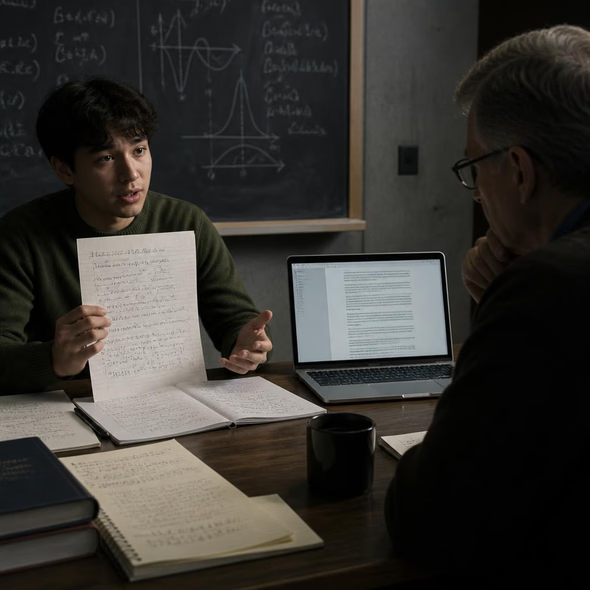
The assignment is not dead, but its old double role has split: AI can manufacture the finished artifact without supplying the student’s intellectual passage through it. MIT should assess learning through several forms of evidence rather than replace one brittle ritual with a more inconvenient one.
MIT is considering changes to its educational model after an ad hoc committee co-chaired by professors Eric Klopfer and Samuel Madden concluded that generative AI can produce credible responses to almost any written undergraduate assignment. The report includes essays, proofs, science and math problems, and coding work. Its warning is not that every generated answer is correct. It is that the finished answer can often look sufficient.
That distinction unsettles a familiar academic object: the take-home assignment. A paper or proof has served as both an exercise and a receipt, the place where thinking occurs and the evidence that a particular student did it. Generative AI can now print the receipt without making the journey. The polished surface remains; its authority has thinned.
Evidence beyond the artifact
Oral defenses can reveal whether students understand their claims, but quick speech is not identical to deep thought. Supervised drafting can expose choices as they happen, but inconvenience is not a learning objective. Laboratories and hands-on projects bind answers to material decisions, while critique and revision show whether a student can recognize weakness and change course. Each method sees something different. None deserves to become the new universal lock.
The better design combines evidence. A student might submit a solution, explain one crucial decision in conversation, respond to criticism, and revise the work. Courses could state where AI assistance is permitted and then ask students to identify what they accepted, rejected, or corrected. The point is not to stage a purity ritual around unaided prose. It is to make judgment visible again.
MIT’s committee also described a campus culture altered beyond formal assessment, including lower office-hour attendance, reduced participation in online discussions, and anecdotal declines in in-person study groups. Those rooms and gatherings once made uncertainty social: a half-formed question could be tested against another mind before becoming a polished answer. An always-available platform offers less embarrassment, but it may also remove the encounter through which a student discovers that confusion is shared.
A serious overhaul should therefore preserve reflection and intellectual risk without confusing hardship with rigor. MIT can pilot mixed assessments, compare whether students transfer knowledge to unfamiliar problems, and publish clear standards for acceptable assistance. The next useful proof will not be that a student can produce an immaculate artifact. It will be that the student can explain, defend, revise, and use what the artifact claims to know.
Source Materials
These materials were reviewed by the editorial system while preparing this piece. Muerte.casa may interpret, satirize, reframe, or disagree with them.
- MIT Warns That AI Can Now Credibly Complete Pretty Much Any Undergrad Assignment, Considers Overhaul of Entire Educational Model Futurism · August 30, 2026 · Primary signal · Direct source
How did this story land?
This may be changed as you like.