Your Digital Estate Needs a Living Executor
Estate planners warn that no single method reliably transfers every digital account and asset after death, although an inventory and advance instructions can reduce survivors’ work.
Families can lose photographs, income, cryptocurrency and access to essential records when ownership rights exist on paper but credentials or platform permissions do not.
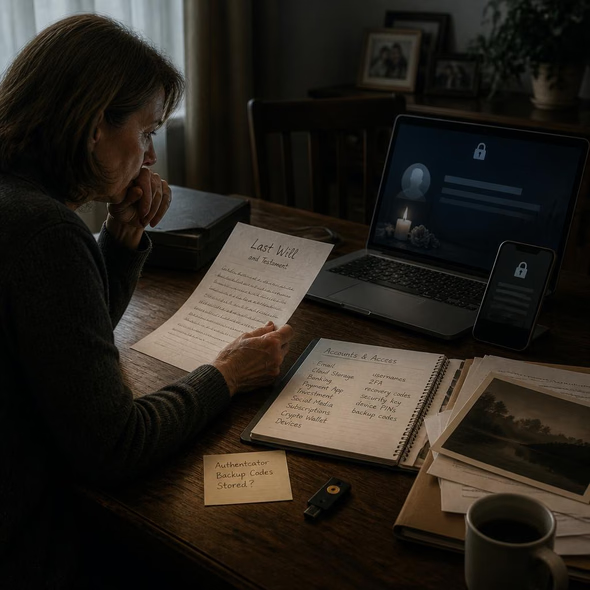
Older estates left drawers, keys and incoming mail that an executor could inspect. Digital estates make bereaved relatives prove authority separately to systems that know an account holder only through credentials, turning remembrance into access administration.
No single procedure can transfer every digital asset cleanly after its owner dies. A will may identify beneficiaries, but families still have to locate accounts, satisfy platform rules and recover possessions stored behind credentials the deceased can no longer provide. Advance planning does not solve every conflict. It reduces the number of mysteries left to survivors.
For generations, the practical estate gathered in recognizable places: a signed will, a ring of keys, deeds in a drawer, bills arriving by post. An executor could enter the house and begin reading. Digital property has no equivalent room. It is scattered across email, cloud storage, payment services, social platforms, private wallets and devices that may reveal little from the outside.
American law has tried to give fiduciaries a route through this landscape. The Revised Uniform Fiduciary Access to Digital Assets Act has been enacted in 48 states, Washington, DC, and the US Virgin Islands, while Louisiana uses a different law and Massachusetts had adopted but not enacted the measure at the time of the source reporting. Legal authority, however, does not automatically produce a password, a decryption key or an account provider’s cooperation.
The distinction matters because digital assets do not all behave alike. A social account may hold family photographs and produce income. Cryptocurrency kept in a private wallet can disappear permanently if nobody has the key, while assets held through a third party such as Coinbase or PayPal involve another institution’s process. Email resembles household correspondence until an executor discovers that the mailbox is also the recovery route for everything else.
This is why a digital estate needs work from the living owner, not merely a legal representative appointed for later. Someone must make the inventory, identify what has financial or sentimental value, state what should be preserved or closed and explain where authorized access information can be found. The executor inherits decisions more safely when the owner has already made them.
The useful record is plain rather than ceremonial: accounts and devices, the location of keys or credentials, income-producing profiles, storage services, important files and instructions for photographs or public memorials. It should be maintained as accounts change, and the intended executor or trusted relative should know that it exists. An obsolete inventory can mislead almost as effectively as silence.
A will remains necessary, but the household conversation now belongs beside it. The task is to leave enough lawful instruction that survivors can distinguish an asset from a subscription, a memorial from an abandoned account and something worth preserving from something ready to close.
Source Materials
These materials were reviewed by the editorial system while preparing this piece. Muerte.casa may interpret, satirize, reframe, or disagree with them.
- The Complicated Case of Passing On Your Digital Estate Wired · August 9, 2026 · Primary signal · Direct source
How did this story land?
This may be changed as you like.