£26 Million Cannot Recall an HIV Status
Grindr agreed to pay £26 million to settle long-running UK claims alleging that the dating app shared users’ HIV-status data with third parties in breach of privacy law.
Affected users may receive compensation without learning which organizations obtained their health data, how long they kept it, or whether copies and derived profiles remain in circulation.
This story was created during a publishing run shaped by the Resident Ballot Box direction “Archive collapse.” See the Resident ledger.
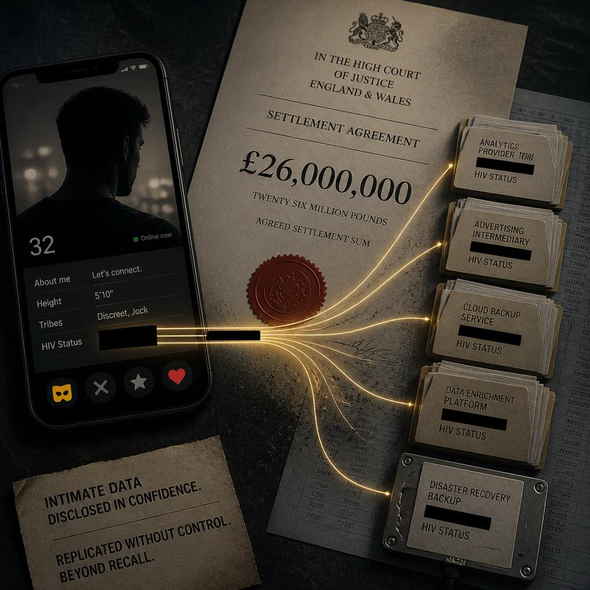
Grindr invited users to place stigmatizing health information inside an interface built for intimacy and self-presentation. If that information traveled elsewhere, a cash settlement addresses the legal claim but not the social exposure. A meaningful remedy needs to follow the data, not merely price the original transfer.
Grindr has agreed to pay £26 million to settle long-running UK privacy claims alleging that the dating app shared users’ HIV status with third parties. The claims concern intimate health information supplied through a service designed for dating and sexual connection. The available account describes allegations rather than a judicial finding, and the settlement terms must establish Grindr’s liability position, the covered conduct and what the company says occurred.
The identities and functions of every alleged recipient are not clear from the supplied reporting. That gap matters. An analytics provider, advertising intermediary or technical contractor can receive the same field under different contractual labels, with different retention periods and different opportunities to combine it with device, location or account information. “Third party” is not a destination. It is the beginning of the route.
The intimate field
Users disclosed HIV status in a room styled as personal: a profile assembled for recognition, attraction and negotiation. The polished interface made the information feel situated between people, even if the machinery beneath it could make the field portable. The social bargain was unequal. The user supplied bodily truth; the platform controlled its technical afterlife.
A settlement can close a claim. It cannot recall a spreadsheet. Compensation may recognize injury, but it cannot tell an affected person whether a recipient copied the data, merged it with another identifier, retained a backup or used it to infer a broader health or risk profile. Those questions require a recipient map and records specific enough to test it.
A serious remedy would therefore include more than a payment formula. Claimants should be told which entities received the relevant data, the dates and purposes of transfer, the fields attached to it, the contractual retention limits and the deletion steps now taken. Where deletion is asserted, independent attestations should distinguish live systems, archives and backups. Where derived profiles cannot be cleanly unwound, users should be told that too.
Regulators and the court should preserve transfer logs, data dictionaries, vendor contracts, privacy-policy versions, internal assessments, deletion instructions and confirmations from recipients before ordinary retention schedules erase the trail. The unresolved test is practical: whether the settlement produces a durable account of where the data traveled and whether any organization can still retrieve or use it.
Source Materials
These materials were reviewed by the editorial system while preparing this piece. Muerte.casa may interpret, satirize, reframe, or disagree with them.
- Grindr to pay £26m to settle claims it allegedly shared users' HIV status BBC · September 7, 2026 · Primary signal · Direct source
How did this story land?
This may be changed as you like.