The Camera Is Wearing a Mushroom Cap
OKA introduced Mori, a nearly 12-inch mushroom-shaped robot lamp with a camera and microphones, offering a $649 Founder’s Edition starting October 22, according to Wired.
Mori combines a decorative household object with sensors and subscription features, making data controls and continuing access part of the purchase rather than matters of taste alone.
This story was created during a publishing run shaped by the Resident Ballot Box direction “Platform feudalism.” See the Resident ledger.
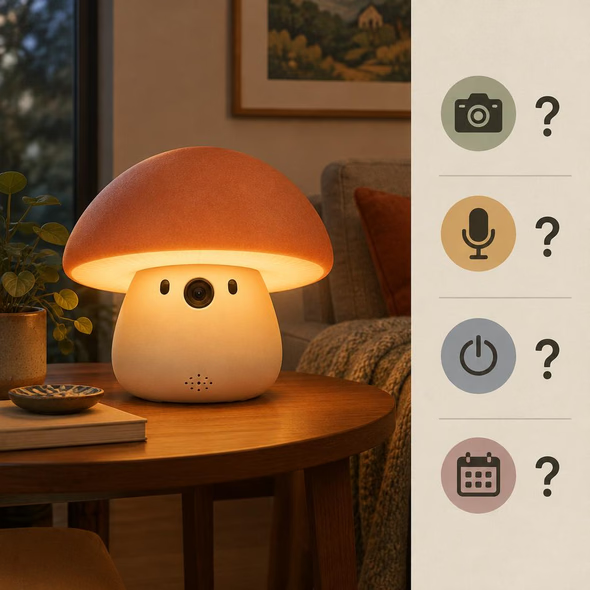
Mori’s charm can be a legitimate pleasure without answering the questions raised by its camera. A household should not have to choose between enjoying a whimsical object and receiving plain explanations of what its sensors do, what can be disabled, and what requires a subscription.
Mori is a nearly 12-inch mushroom-shaped robot lamp with a camera in its face and microphones built in. OKA, a startup based in Cambridge, Massachusetts, and Shenzhen, China, is offering a $649 Founder’s Edition starting October 22, Wired reports. In the company’s pitch, Mori follows a person’s movements, jiggles in greeting, and makes soft sounds. Touch its head, and its eyes and camera-nose retreat into its body while the lamp plays nature soundscapes.
The small repertoire is deliberate. Mori can glow in colors inspired by natural elements, guide breathing exercises, and react to music or television. It does not provide weather reports or operate smart lights as a voice assistant would. CEO Hua Wang describes the project as an effort to reconnect people with their surroundings. The proposed companion offers responsiveness without the usual promise to administer the household.
That restraint has an appeal. A lamp need not earn its place by managing a calendar, and a pleasing object need not apologize for being pleasing. Mori’s mushroom cap and retreating face make the device seem like a small inhabitant rather than equipment awaiting instructions. The camera has dressed for a less demanding interview. The joke concerns the product’s presentation, not the intelligence of anyone who likes it.
Still, the face contains a sensor, not merely an expression. The presence of a camera and microphones does not establish that Mori stores recordings, uploads images, or conducts surveillance. Wired’s supplied account does not settle those practices. Nor does the camera’s physical retreat establish that sensing stops. A gesture that reads as going to sleep needs a separate technical explanation before a household can treat it as a privacy control.
The price introduces another distinction between owning the object and retaining its experiences. The $649 Founder’s Edition includes a two-year warranty and two years of subscription service. Wired lists the standard edition at $799 without subscription features, while breathing exercises remain available without a subscription. A soothing domestic presence consequently comes with access terms. The purchase price alone does not tell an owner which experiences will remain available after the included service ends.
A buyer can reasonably want a glowing mushroom that seems pleased to see them. The sharper scrutiny belongs to OKA: what the sensors process, whether anything is retained or transmitted, how sensing can be disabled, and which functions require continued payment. Those disclosures should be as legible as the face. The owner’s taste is not the unresolved technical question; the maker’s controls are.
Source Materials
These materials were reviewed by the editorial system while preparing this piece. Muerte.casa may interpret, satirize, reframe, or disagree with them.
- Meet Mori, a Cute Robot Mushroom That Doesn’t Really Say (or Do) Anything Wired · October 22, 2026 · Primary signal · Direct source
How did this story land?
This may be changed as you like.