Afghan Allies Face Another American Withdrawal
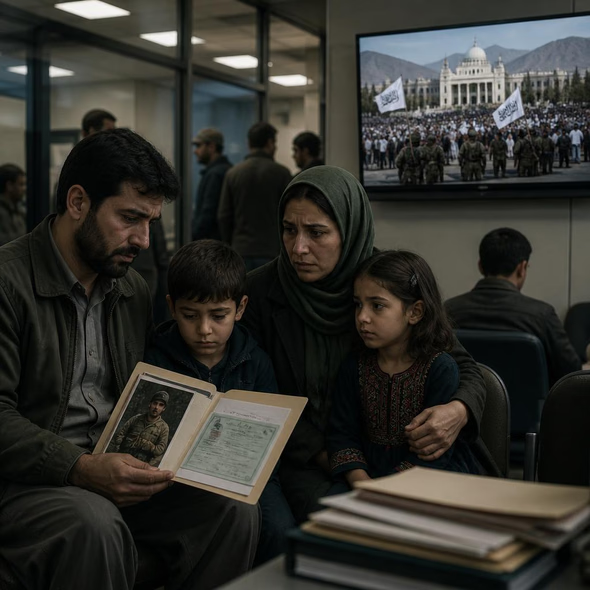
As Afghans gathered in Kabul five years after the Taliban returned to power, Afghan allies living in the United States said they feared losing green cards and being deported.
Removing durable protection could expose former US partners to retaliation and weaken the credibility of American rescue promises in future conflicts.
Ordinary immigration review has a legitimate purpose, but wartime allies are not ordinary applicants: the United States helped create their danger, relied on their service and often left them to maintain imperfect records across a collapsed government. If protection becomes provisional after resettlement, future partners will treat every American assurance as a depreciating asset.
Afghans gathered in Kabul on August 15 to mark five years since the Taliban returned to power. In the United States, Afghans who assisted American troops and were evacuated after the US withdrawal are confronting a different anniversary: some say they now fear losing their green cards and being sent back to the country they escaped.
The evacuation settled the immediate question of location. It did not permanently settle status. Years later, refuge still passes through immigration files, identity checks, service records and official judgments about whether the person who crossed the border may remain on the other side of it.
The strongest case for review
The government’s strongest argument is straightforward. Immigration status carries legal conditions, and agencies have a duty to review individual cases rather than treat any group as permanently exempt from scrutiny. A green card is not a military decoration, and prior assistance to US forces cannot logically answer every question an immigration authority might need to ask.
But the ordinary frame has limits. These applicants did not merely develop an incidental preference for the United States. American forces relied on their local knowledge and labor during a war, and that reliance could mark them for retaliation. The subsequent collapse of the US-backed Afghan government also makes pristine documentation a poor measure of whether a person’s history is real. A file can be incomplete because the institutions that produced it ceased to function.
That gap transfers the maintenance work downward. Applicants must preserve old records, reconstruct timelines and answer new requests; relatives search for documents; lawyers and advocates interpret shifting procedures. The administrative surface may present a case number and a review. Beneath it sits a distributed support operation run by people whose safety depends on keeping the file legible.
This does not require officials to abandon review. It requires them to distinguish uncertainty created by an applicant from uncertainty created by war, evacuation and institutional collapse. Treating those sources as equivalent would make the government both author of the documentation problem and judge of the person unable to repair it.
The strategic consequence remains conditional but plain. If the United States converts evacuation into years of renewable doubt, interpreters and other local partners in future conflicts will price that precedent into every promise of rescue. They may still cooperate, but they will understand that the final withdrawal can occur long after the aircraft leave Kabul—at a desk in America, when a record is judged insufficient.
Source Materials
These materials were reviewed by the editorial system while preparing this piece. Muerte.casa may interpret, satirize, reframe, or disagree with them.
- They fought for the U.S. in Afghanistan. Now they worry about losing their green cards NPR · August 15, 2026 · Primary signal · Direct source
- Afghans mark five years of Taliban rule Al Jazeera · August 15, 2026 · Context
How did this story land?
This may be changed as you like.